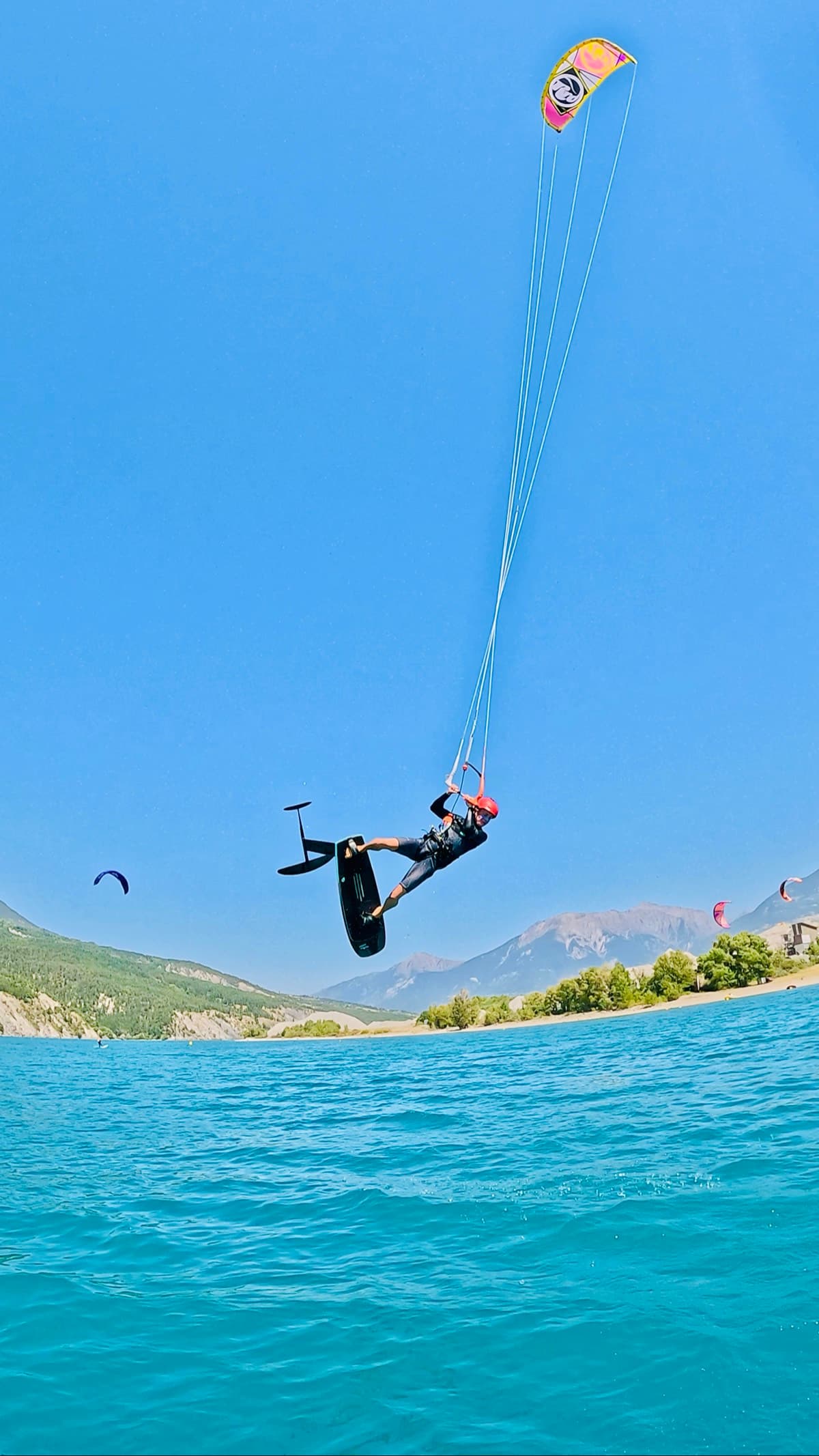
The foil is a wing underwater attached to the board by a mast. Once launched, it lifts the board: no more friction, a silent glide, and navigation possible from 8 to 10 knots.
The parts of a foil
- The mast: from 60 to 105 cm. A short mast (60 to 75 cm) is reassuring for beginners, while a long mast allows you to fly in choppy water and lean more.
- The fuselage: the bar that connects the front wing to the stabilizer. Short = more maneuverable, long = more stable.
- The front wing: it generates lift. Large surface area (over 1,000 cm²) = takes off early and slowly, ideal for learning. Small surface = faster and more technical.
- The stabilizer (stab): the small rear wing that balances the whole setup.
The first setup
| Element | For beginners |
|---|---|
| Mast | 60 to 75 cm |
| Front wing | Large, high lift, low aspect ratio |
| Fuselage | Medium to long, for stability |
| Board | With straps, enough volume to start |
The kite wing for foil
The foil requires 30 to 40% less surface area than a twintip. A freeride kite works great; foil kites (with cells) and single skin kites are even more effective in light wind.
Which size for you?
Board
Suggested size
6m²
5 to 7 m²
Indicative: each model has its own range, check riders' reviews on low end and depower.
Common mistakes
- Too much power in the kite: the foil takes off too quickly and you fall forward.
- Weight too far forward or backward: place your feet above the mast and adjust gradually.
- A spot that is too shallow: you need at least the length of the mast plus some margin under the board.
Wear a helmet and an impact vest: foil wings are sharp and falls can be surprising.