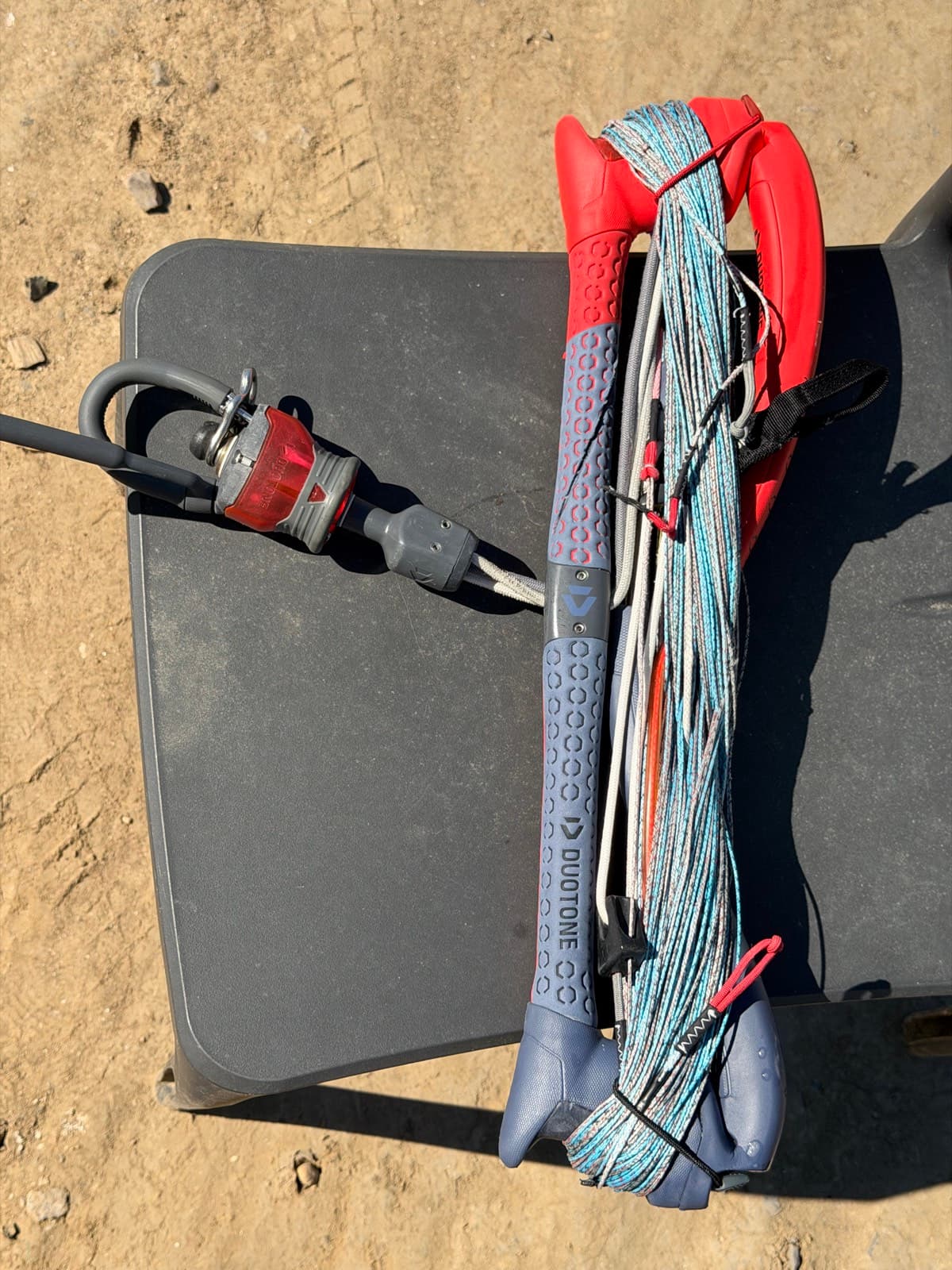
The bar is your steering wheel, your accelerator, and your brake. It's also where your safety system is located, the most important piece of your gear.
The Elements of a Bar
- The bar itself, with its floats and ends.
- The chicken loop: the loop that attaches to your harness.
- The quick release: it opens the chicken loop with a push and cuts the power. Test it at every session.
- The depower (trim): a cleat or pulley to adjust the power of the kite according to the wind.
- The safety line: after releasing, the kite remains connected to you by a single line and depowers.
- The leash: it connects your harness to the safety line.
Bar Length
It is often adjustable between 38 and 55 cm. Short bar = softer and more responsive kite for smaller sizes. Long bar = more leverage for larger kites.
| Kite Size | Recommended Bar Length |
|---|---|
| 5 to 8 m² | 38 to 45 cm |
| 9 to 12 m² | 45 to 52 cm |
| 13 m² and more | 52 to 55 cm |
Line Length
The standard is 22 to 24 m. Extensions lengthen the window (useful in light wind); shorter lines make the kite more lively (wave, strong wind).
4 or 5 Lines
Today, almost all kites are flown with 4 lines. The 5th line mainly exists on certain C-shape freestyle kites.
Compatibility
A bar is primarily compatible with kites from its brand: line lengths, colors, and settings match. It can work between brands, but check the line lengths beforehand (tolerance of a few centimeters).
Lines wear out and stretch: have them measured and equalized once a season, and replace them as soon as they fray.