France
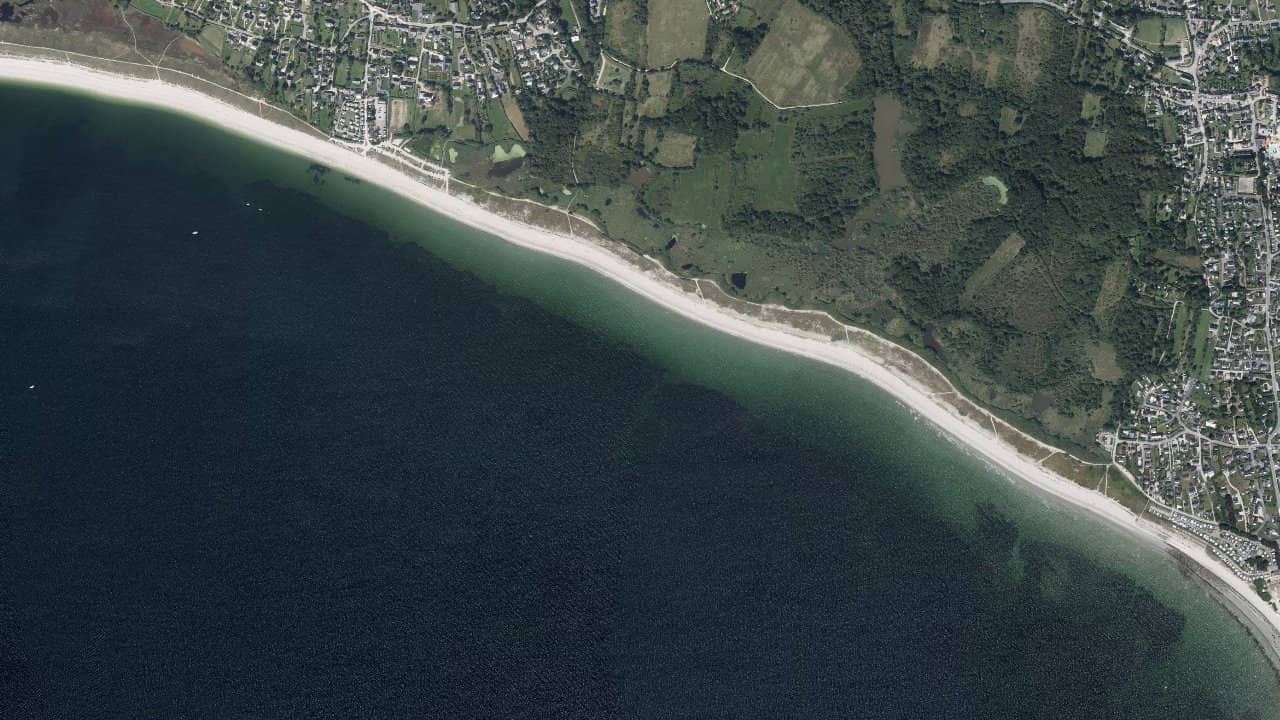
The Landrezac beach in Sarzeau, on the Rhuys peninsula in Brittany, stretches over more than 5 km of fine sand between Suscinio and Penvins. It is a main spot in the region, easily accessible with two parking lots and a wild environment that appeals to riders.
A kitesurfing zone allows for safe navigation, with a rescue station on site. Local schools offer courses for all levels, from beginner to advanced, and the spot often works at all tides.
Protected by the Quiberon peninsula, the beach provides an ideal setting to progress with minimal risks.
The wind data shown here comes from ERA5 (via Open-Meteo) over 4 years, reprocessed to reflect realistic conditions.
👉 Average wind has been calibrated to avoid the usual underestimation of models.
👉 Gusts have been corrected by a median ratio to avoid unrealistic extreme values.
👉 Each day is summarized by the median wind (P50) observed during useful hours (8am–8pm), then classified into wind ranges.
👉 The weighted mode mixes average wind and gusts to best reflect felt wind.
The spot works well with winds from the west to southwest, which come in side-on relative to the west-facing beach. At low tide, you have a wide flat area perfect for navigation and progression, ideal for waterstarts and first sessions. At high tide, a nice swell forms, adding fun for intermediate riders who enjoy some waves.
Launching is easy on the sand, and the take-off area adapts to the tide: at low water, everything is exposed and spacious; at high water, stay in the reserved zone to avoid bathers. Schools like Kite2Rhuys or EKO KITE often use this spot for beginners in southwest winds, and move to deeper water or by boat if needed. There is no north wind here, but all other orientations work by adjusting the area.
The water remains protected from the waves of the open sea thanks to Quiberon, with little chop except in strong winds. It is an excellent school spot, safe for initiation, and versatile year-round depending on the tides.
The ideal conditions are winds from west to southwest between 15 and 25 knots, side-on, at low tide for pure flat conditions. In stronger winds, the swell at high tide adds excitement without being too challenging.
The water surface is flat at low tide over a large sandy area, and transitions to light chop with short swell at high tide. Protected from the open sea, it is rarely choppy, perfect for riding calmly.
Currents are generally weak in the gulf, but they intensify with high tide coefficients. It is important to check the schedules, as the amplitude is significant in Brittany: up to 5-6 meters. Stay vigilant near the channels.
Opt for sizes from 9 to 11 m² in light to moderate wind, and 7 to 9 m² when it picks up. Adjust according to your weight and level, with a directional twintip for the flat.
The prevailing wind comes from the west and southwest, often regular and thermal in summer. It blows an average of 15-25 knots in the afternoons, reinforced by Atlantic depressions in winter. There is no specific local name, but it is reliable on the Rhuys peninsula.
The Breton climate is oceanic, with mild temperatures year-round: around 10-15°C in winter and 20-25°C in summer. The seasons are marked by frequent rains, but kite sessions remain possible even in the off-season thanks to the regular wind.
The depth is gradual with a completely sandy bottom. You can stand up to 50-100 meters from the shore at low tide, which secures falls and relaunches.
The water is cool: 10-13°C in winter and spring, 16-20°C in summer. A 5/3 mm wetsuit is mandatory outside the summer season, and a shorty is recommended in July-August.