France
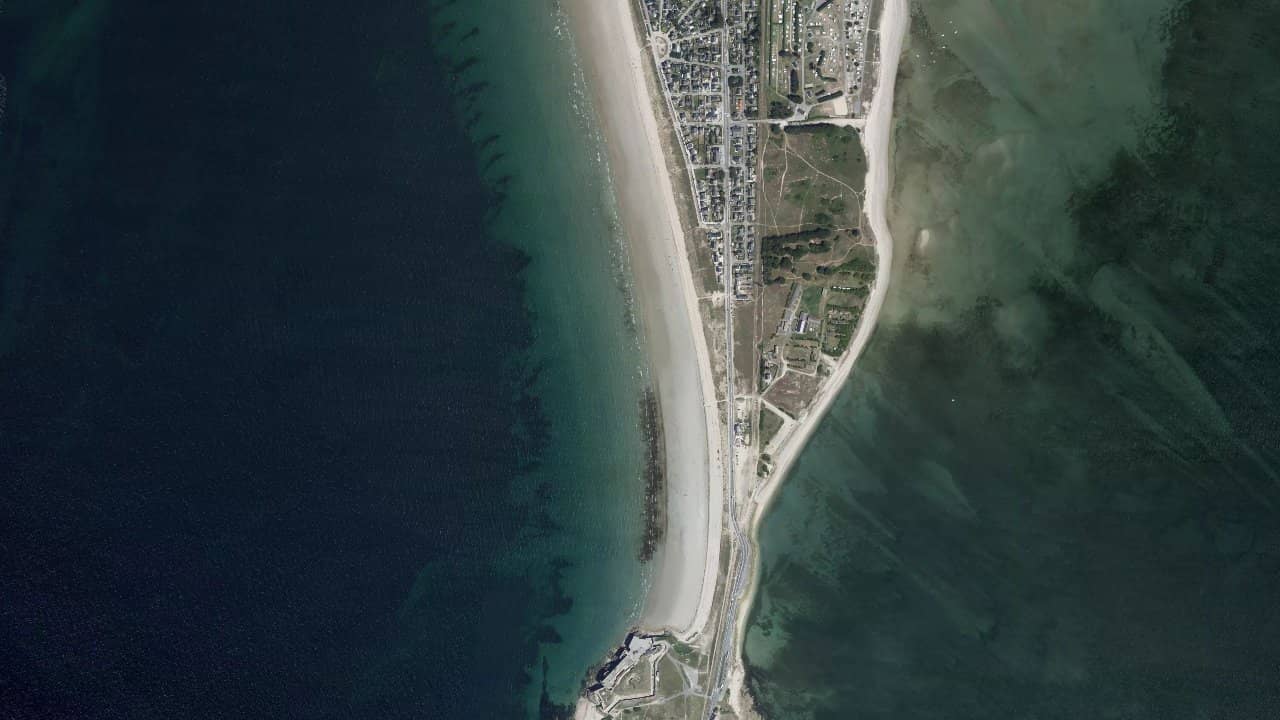
Penthièvre beach, located in Saint-Pierre-Quiberon on the Quiberon peninsula in Brittany, is a legendary spot that offers two distinct faces. On the ocean side, there is a wide and open beach ideal for freeride and wave sessions, while on the bay side, it is a sheltered water area perfect for progressing quietly.
The narrow isthmus allows easy passage from one side to the other depending on the wind, making it a versatile place all year round. Local kite schools regularly offer lessons, and the parking is convenient for loading gear.
It is a popular spot for Breton riders due to its consistent wind and variety of conditions, from flat to chop depending on the tide and wind direction.
The wind data shown here comes from ERA5 (via Open-Meteo) over 4 years, reprocessed to reflect realistic conditions.
👉 Average wind has been calibrated to avoid the usual underestimation of models.
👉 Gusts have been corrected by a median ratio to avoid unrealistic extreme values.
👉 Each day is summarized by the median wind (P50) observed during useful hours (8am–8pm), then classified into wind ranges.
👉 The weighted mode mixes average wind and gusts to best reflect felt wind.
The spot works with almost all wind orientations thanks to its two sides. On the bay side, with east or northeast wind (perfect side-on or side-shore), the water is ultra-flat even in strong wind, ideal for freestyle and learning. The launch is done south of the municipal camping, but you often have to wait for low tide as the beach completely disappears at high tide; otherwise, launch further north on the Sables Blancs beach.
On the ocean side, with west or northwest wind (onshore or side-off), it’s freeride with waves that quickly increase in power in strong wind. The launch area is wide and safe, with a dedicated zone in summer. Navigation remains in the marked area to avoid swimmers, and the water transitions from chop to serious waves depending on the swell. The narrow isthmus (22m) allows easy switching from one side to the other.
Local peculiarity: tides are significant (often high coefficients in Brittany), so always check the schedules. Foot everywhere on the bay side at low tide, up to several hundred meters. Schools like Kite Spirit or Rêve de Glisse set up for courses.
The ideal conditions are an east wind of 15-25 knots on the bay side for pure flat, or west wind of 20-30 knots on the ocean side for rideable waves without being monstrous. Side-on on both sides for consistent power.
On the bay side, the water is smooth and flat, perfect for riding even in strong winds. On the ocean side, it quickly transitions from chop to powerful waves, stirred by the Atlantic swell. Tides influence everything: beach exposed at low tide on the bay side, shorter waves at high tide.
Currents are moderate on the bay side but can intensify near the oyster parks. On the ocean side, they are stronger with the swell and significant tides in the region (amplitude up to 5-6m). Always be cautious near channels and when exiting the marked area.
Opt for sizes from 9 to 11m² in light summer wind on the bay side, and 7 to 9m² in strong wind or on the ocean. Adjust according to your weight and level, with versatile kites to switch sides.
The wind is consistent due to the exposed position of the peninsula. There is no specific local name, but we often have strong west winds in winter (20-35 knots) for the ocean side, and east winds more thermal in summer (15-25 knots) for the bay. Typical wind score around 73/100 all year round, with all months favorable.
The Breton climate is oceanic, with mild temperatures year-round: around 10°C in winter and 20-25°C in summer. The seasons are marked by frequent rains, but kite sessions are possible 12 months a year thanks to the constant wind. Summer is more stable and crowded, while winter is wilder with storms.
The depth is shallow and gradual on the bay side, with foot everywhere up to 100-200m from the shore at low tide on a sandy bottom. On the ocean side, it rises quickly but remains safe near the beach.
The water is cool: 10-12°C in winter (5/4 wetsuit required), 14-16°C in spring/fall, and 17-20°C in summer. A wetsuit is always recommended, even in summer.