
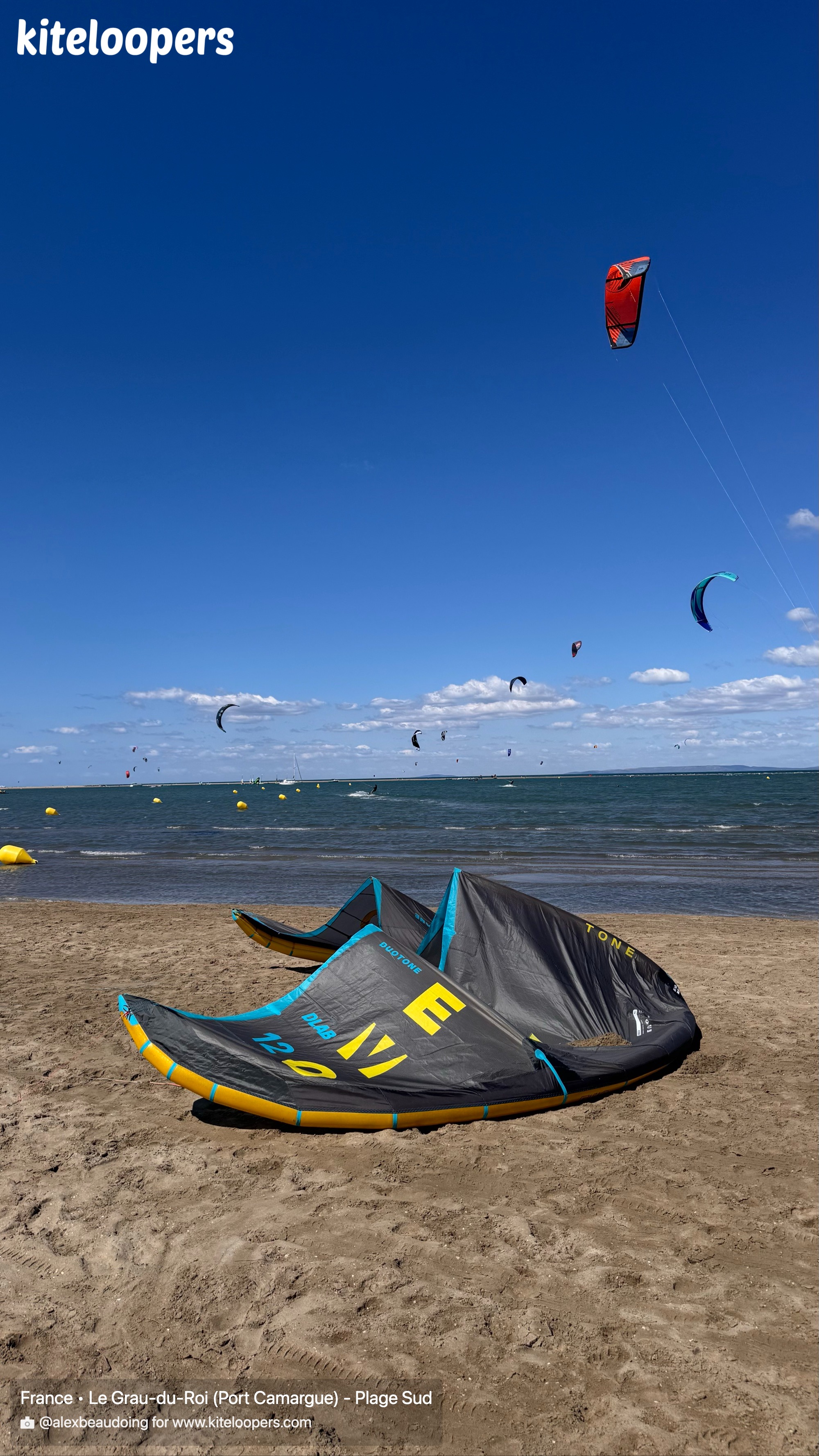
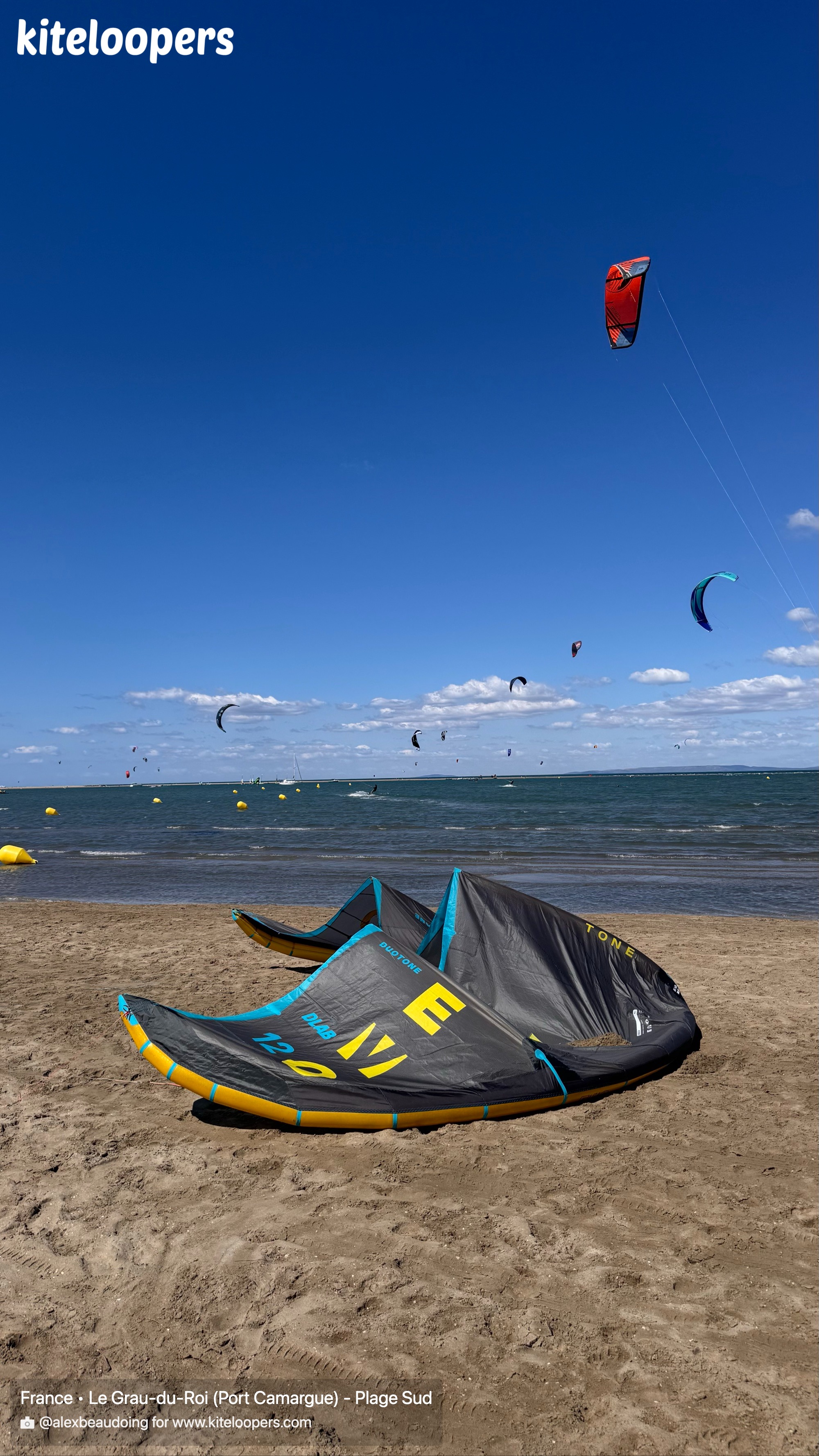
Le Grau-du-Roi (Port Camargue) - Plage Sud
France
Le Grau-du-Roi (Port Camargue)
The South beach at Grau-du-Roi, right next to Port Camargue, is a long sandy bank bordered by several jetties that extend into the sea. It is a very popular spot among local riders, known for its consistent wind and easy access from the parking lot.
Between the jetties and the open sea, the water remains often in shallow water and well protected from the swell. Locals come here to work on their freestyle tricks and big jumps as soon as the Mistral picks up, and the atmosphere is generally friendly yet sporty.
The wind data shown here comes from ERA5 (via Open-Meteo) over 4 years, reprocessed to reflect realistic conditions.
👉 Average wind has been calibrated to avoid the usual underestimation of models.
👉 Gusts have been corrected by a median ratio to avoid unrealistic extreme values.
👉 Each day is summarized by the median wind (P50) observed during useful hours (8am–8pm), then classified into wind ranges.
👉 The weighted mode mixes average wind and gusts to best reflect felt wind.
- 🟢 10–16 kts: light but sailable wind (especially on foil).
- 🟡 16–22 kts: ideal range, comfortable conditions for most.
- 🔴 22–28 kts: strong wind, reserved for experienced riders.
- 🟣 28+ kts: extreme conditions, committed riding.
Location & Points of interest
Useful information
 wave
wave flat
flatThe South beach spot is oriented facing the Mediterranean, with a fairly wide beach and several jetties in line that create different navigation zones. In Mistral winds from the NW to N sector, the wind generally arrives side-off to side-shore right relative to the beach, but the jetties and the sandbank offshore cut the swell and generate beautiful flat areas between the piers. It is in these protected corridors that riders come to seek powerful edging for freestyle and big air.
The spot also works with winds from the W to NE sector, but the wind becomes more irregular and disturbed when it shifts too far North or Northeast due to the terrain and constructions upwind. In South to Southeast winds, the water is choppier with a rather onshore wind, less interesting for pure freestyle but practicable in freeride if the wind is well established. Navigation remains possible almost year-round, but a prefectural order strictly regulates the practice areas in season.
In winter and outside the summer marking period, navigation is generally tolerated over a large part of the beach, providing plenty of space for takeoff and landing. From the nice season (early June to mid-September), a kitesurfing channel is installed in the central part, and navigation must then be done exclusively in this area. A sign at the entrance of the spot reminds of the rules, navigation limits, and the authorized takeoff/landing zone.
Takeoff occurs on a sometimes narrow beach, with wooden stakes planted in the sand for dune protection. Therefore, one must remain very vigilant during ground handling maneuvers and avoid staying too long static with the kite at zenith. The water entry is direct, with a sandy bottom and a gentle slope. Downwind, the jetties remain close, which requires good control of drift, especially in side-off North winds where one must be able to effectively go upwind to exit the corridors between the jetties.
In terms of zones, riders often seek the flat downwind of the jetties for freestyle, while further offshore the water becomes slightly choppy when the wind picks up. The spot is official and very busy on strong Mistral days, with the possible presence of windsurfers and wings. It is important to maintain safety distances, particularly at the exit of the channel and near the rock jetties.
The ideal conditions for South beach are an established Mistral from the NW to N sector, between 18 and 30 knots, providing consistent and strong enough wind to fully enjoy the flat areas under the jetties. In these conditions, the wind is quite side to remain comfortable and allows for good upwind riding without too much drift towards the jetties.
For freeride and big air oriented riders, a NW wind around 20–25 knots offers an excellent compromise between control, jump height, and water quality. Thermals or more moderate South winds can be interesting for a more relaxed ride, but it is clearly with the Mistral that the spot shows its full potential.
The water conditions at South beach are one of the major assets of the spot. The long jetties and the sandbank offshore effectively cut the swell, creating large areas of flat or slightly choppy water between the jetties, perfect for freestyle and committed freeride. In strong Mistral conditions, one can find a true flat just downwind of the jetties, with almost smooth water for executing technical tricks.
As you move a bit away from the jetties and closer to the open sea, the water becomes more choppy, especially when the wind exceeds 25 knots, with a typical Mediterranean chop. In South or Southeast winds, small waves and a shorebreak can form on the beach, but it remains a rather choppy configuration rather than actual surf waves. Overall, the spot offers a good compromise between technical flat areas and more agitated water for fast freeride.
Currents are generally moderate on the South beach, thanks to the protection of the jetties and the fact that there are no significant tidal ranges like on the Atlantic. However, there are return currents along the jetties and in the narrowing areas between the sandbanks, especially when the wind picks up or there is residual swell.
Tidal ranges in the Mediterranean are low, so tides have little impact on the ability to navigate, but small variations in level can slightly alter the depth around the sandbank offshore. The current can also be more noticeable near the channel established in summer for water activities, which requires keeping a bit of distance downwind to avoid getting too close to the jetties.
For an average build around 75–80 kg, riders usually navigate between 7 m² and 11 m² depending on the strength of the Mistral. Very windy winter days or strong Mistral sessions are generally done with 7–8 m², while more moderate sessions in spring or South thermals can be managed with 9–11 m².
Lighter riders will easily go down to 6–7 m² during strong wind events, while heavier riders can use 10–12 m² in lighter winds around 15–18 knots. For foiling, wings of 4–7 m² are usually sufficient as soon as the wind exceeds 12–14 knots.
The wind regime is dominated by the Mistral, a cold and often strong wind from the N to NW sector, which blows regularly for several days in a row. At South beach, this Mistral is the reference wind for freestyle: it comes in rather side-off to side-shore right but the jetties break the swell and allow for a very clean water surface. Gusts can exceed 25–35 knots during strong episodes, attracting big air enthusiasts.
There are also winds from the South to SE (Marin and sea winds), which are more humid, often associated with some swell and a choppier water surface, with a rather onshore orientation. These winds are often less violent, around 15–22 knots, and can sometimes combine with local thermal effects, especially in the nice season. The spot can work with a wide range of orientations between S and N, but it is clearly from NW–N that the conditions are most exploited by locals.
Grau-du-Roi enjoys a Mediterranean climate with hot, dry summers and mild winters. In summer, air temperatures often hover around 28–32 °C during the day, with many sunny days and little rain. Spring and autumn still offer pleasant temperatures, often between 18 and 25 °C, with many rideable days.
In winter, temperatures drop to around 8–14 °C during the day, but the Mistral wind can enhance the feeling of cold. The area is still rideable year-round thanks to the frequency of Northwest winds and thermals. The high tourist season (June to September) brings a strong influx to the beach and stricter zoning for practice areas, but the climate remains very favorable for kitesurfing from early spring to late autumn.
Between 0.5 and 2 meters depending on the tide and the sandbanks. Soft and safe sandy bottom.
In summer, water temperature generally hovers around 23–25 °C, allowing for riding in a shorty, or even in lycra for the more resistant. In spring and autumn, the water is cooler, often between 16 and 20 °C, and a 3/2 mm or 4/3 mm wetsuit is recommended.
In winter, the Mediterranean drops to around 12–14 °C in the area, and a 5/4 mm wetsuit with booties becomes almost essential, especially in cold Mistral conditions. However, riding remains entirely possible year-round for those who are well equipped.