France
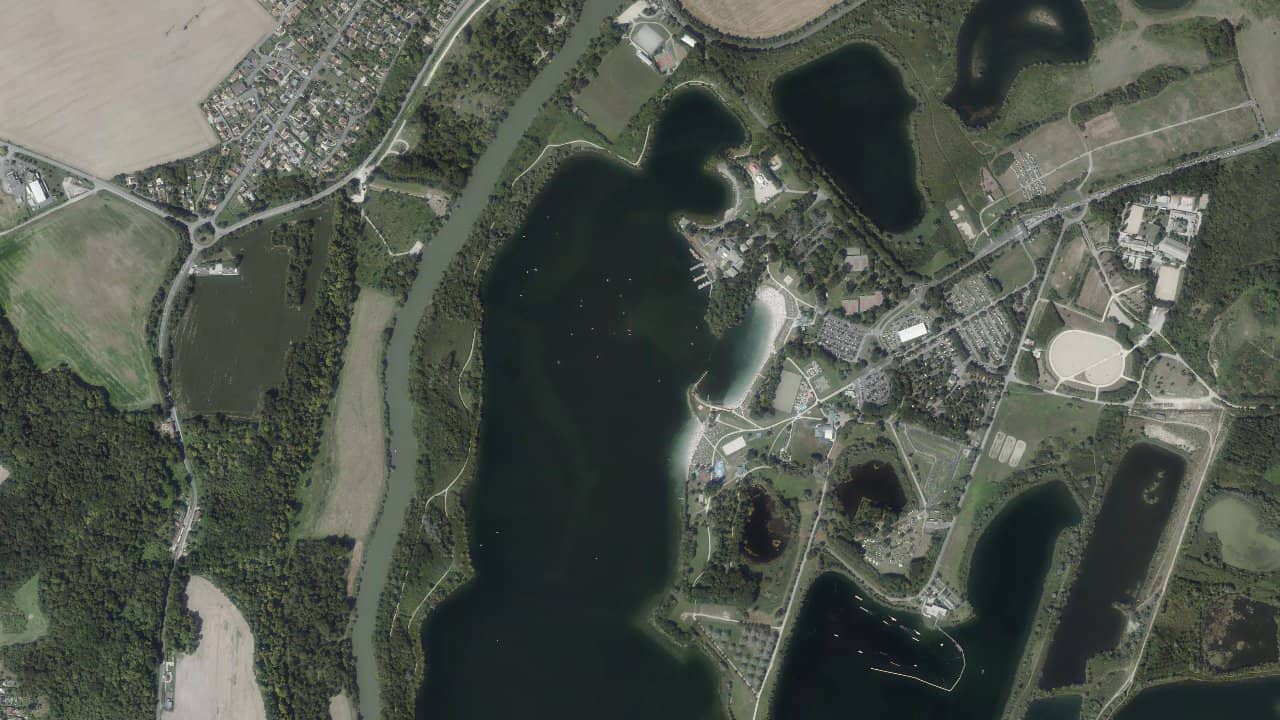
The North beach of Lake Jablines is located in the heart of the leisure island, about forty kilometers east of Paris. It is a large equipped water sports base, with a white sandy beach and a fairly regular rectangular body of water.
The North beach is primarily a swimming area in summer, but outside of supervised hours, local riders come to sail on wind, wing, and sometimes kite. The atmosphere is quite calm, with a mix of regular riders from the Paris region and practitioners who come to test the spot for the day.
The wind data shown here comes from ERA5 (via Open-Meteo) over 4 years, reprocessed to reflect realistic conditions.
👉 Average wind has been calibrated to avoid the usual underestimation of models.
👉 Gusts have been corrected by a median ratio to avoid unrealistic extreme values.
👉 Each day is summarized by the median wind (P50) observed during useful hours (8am–8pm), then classified into wind ranges.
👉 The weighted mode mixes average wind and gusts to best reflect felt wind.
The main lake of Jablines is generally oriented North-South, making it particularly interesting with South, South-West, or North winds, which then arrive across or in the axis of the water surface. The North beach is located on the northern shore of the water surface, which gives a rather side-on to onshore wind when it blows from the South or South-West, and off/side-off with North wind, less comfortable for safety.
The sliding practice takes place on the large lake of 75–80 hectares, with a wide and clear navigation area. Launching generally occurs from the beach or from the area near the North parking, where access to the water is very quick from the car. In the summer season, the North beach is a supervised swimming area, and navigation is then heavily constrained, even impossible during supervision hours. Outside of these hours and very busy periods, riders use the part of the water surface outside the marked swimming areas.
The water surface is flat to slightly choppy depending on the wind strength. With a steady wind around 15–20 knots, there is a good little lake chop, but no real waves. The water surface remains relatively regular, which is ideal for freeride, foil, and freestyle. The central area of the lake is perfectly clear, without rocks or sandbanks, allowing for long runs in the wind's axis.
However, one must take into account some local peculiarities. In summer, the lake can be affected by the development of algae, especially during hot and prolonged windless periods, which can hinder foils and create drag on lines or fins. A call to the water sports base before heading out in mid-summer is a good habit to check conditions. The water surface is surrounded by leisure base facilities (parking lots, lawns, paths), so the wind can be a bit disturbed at the edges in certain orientations, but it is generally clean as soon as one moves away from the shore.
The take-off/landing of the kite is done on a relatively wide sandy beach, but one must deal with the possible presence of bathers in season and with the rules of the leisure island. In practice, Jablines is more regularly frequented for wingfoil and windsurfing, which are better tolerated on this type of inland water, but some kiters sail there when attendance is low and the wind is well oriented. The spot works all year round, but the best experience is outside of high season, during the week or in the interseason, with a calmer water surface and simpler management of coexistence with other users.
The ideal conditions at Jablines are found with a well-established South, South-West, or North wind between about 12 and 20 knots. A South or South-West wind brings a side/side-on flow relative to the North beach, with a well-usable water surface along the entire length of the lake. For wingfoil and windsurfing, a bit more wind is comfortable, while in kite, one can enjoy even the slightest well-formed breeze if well powered.
The water surface of Jablines is flat to slightly choppy. With a steady wind of 12–18 knots, a small chop forms in the wind's axis, but no waves break, making the spot particularly suitable for freeride, foil, and freestyle. The higher the wind, the more pronounced the chop becomes in the middle of the lake, but it remains far from a rough sea.
Near the edges, the water surface is often a bit more sheltered, with flatter water, useful for maneuvers or learning. The bottom is uniform, without major reliefs or obstacles. In summer, the presence of algae can slightly alter the glide sensation, especially for foils or boards with large fins, which may catch on the densest clumps.
Jablines is an artificial lake, so there are no tides and the currents are negligible for kite or foil practice. One can feel a slight water movement related to the sustained wind along the length of the lake, but it remains very weak and has no major impact on navigation. The absence of current makes it a reassuring spot for riders coming from the seaside who do not want to deal with the effects of tides or current bars.
For a weight around 75–80 kg, one generally uses kites of 10 to 12 m when the wind is around 12–16 knots, and kites of 7 to 9 m when it exceeds 18–20 knots. Lighter riders may go down to 7–9 m from 15–18 knots, while heavier riders will keep sizes of 11–13 m in the average wind of the Paris region. Foil practitioners can sail with smaller sizes, around 6–9 m, as soon as the wind is stabilized.
The wind regime at Jablines is marked by Atlantic depressions and the passage of fronts, as is the case throughout Île-de-France. The most interesting winds for sailing are generally South, South-West, and North winds, which work well with the North-South orientation of the lake and are explicitly cited as optimal for foil sailing at this spot. In practice, one often sails in a range of 10 to 20 knots, with stronger days during autumn or winter storms.
South to South-West winds arrive quite regularly on the water surface, with a wind that is rather side/side-on relative to the North beach, providing reassuring conditions. North winds are also utilized, but they are colder in winter and can be a bit more irregular. Thermal wind is weak to almost non-existent compared to coastal spots: here, one mainly depends on synoptic weather forecasts, with some days being perfectly calm. The spot is therefore to be favored when a good wind window is announced for the Paris region.
Jablines enjoys a typically Île-de-France climate, with cool winters and moderately warm summers. In winter, air temperatures often hover around 5–8 °C during the day, with possible colder spells. In spring and autumn, temperatures gradually rise to 10–18 °C, providing more comfortable conditions for sailing with an appropriate wetsuit. In summer, the air can easily reach 25–30 °C during hot periods, but the lake remains subject to the typical wind variations of the Paris region.
The sailing season is possible all year round for the most motivated, but the most pleasant period for most riders is from May to September, targeting windy days or disturbed passages. Outside of summer, the body of water is calmer in terms of attendance, which is interesting for kite and foil.
The depth of the lake is gradual from the beach, with a bottom made of sand or fine gravel in the swimming area. One can generally stand in several tens of meters, which reassures learners. Further out, the lake reaches a greater depth, but the bottom remains regular and without major obstacles. The absence of rocks and marked reliefs is a real plus for safety, especially during falls in foil or twin-tip.
The water of Lake Jablines is cold in winter, with temperatures that can drop to around 4–7 °C, necessitating a thick wetsuit (5/4 mm or more, hood, gloves, booties). In spring, the water gradually rises to 10–14 °C, allowing for sailing with a well-equipped 4/3 mm wetsuit. In summer, the water temperature can reach or exceed 20–24 °C during hot periods, making sailing much more comfortable, sometimes possible in a shorty or 3/2 mm. In autumn, the water remains pleasant until October around 15–18 °C before dropping.