France
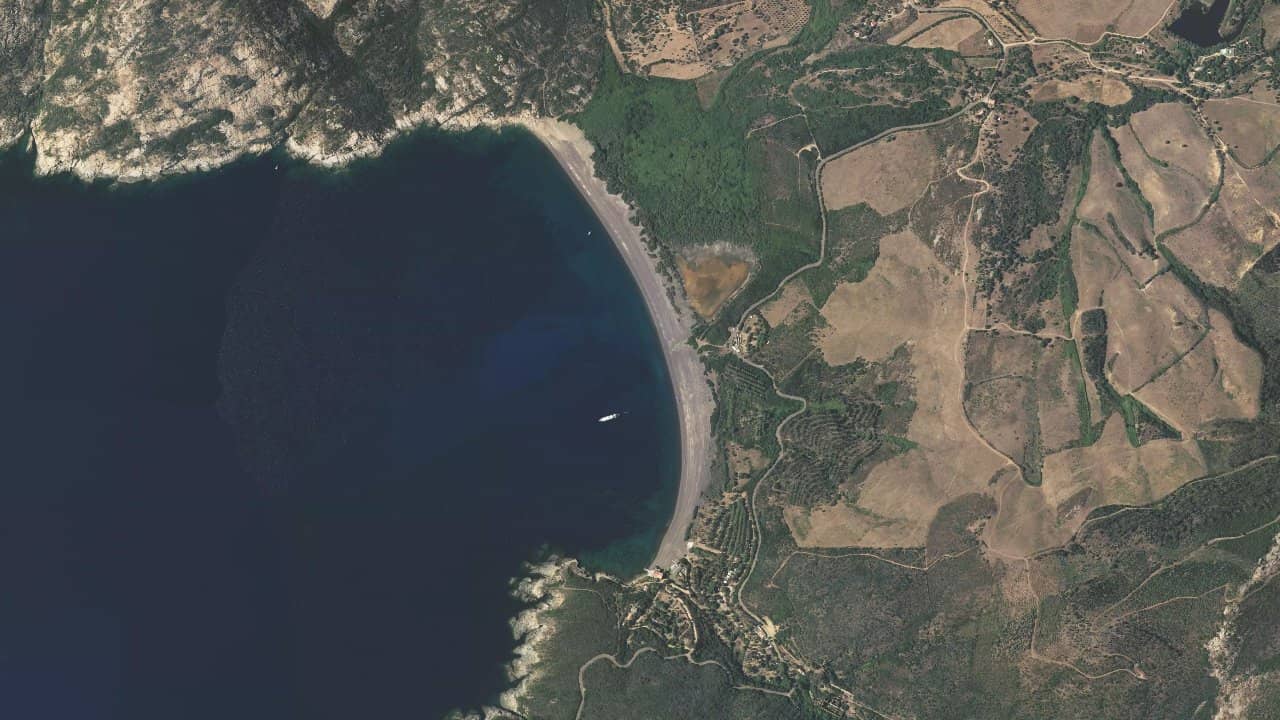
The beach of Argentella, in Calenzana, is a wild spot in Balagne, in the northwest of Corsica. The pebble beach is little frequented and offers a simple setting, with space to rig and navigate away from the busiest areas of the island.
It is a popular spot when there is westerly or northwesterly wind, with navigation often directly along the shore. The atmosphere remains natural, with less convenient access than on the large tourist beaches, but a real interest for riders looking for a quieter place.
The wind data shown here comes from ERA5 (via Open-Meteo) over 4 years, reprocessed to reflect realistic conditions.
👉 Average wind has been calibrated to avoid the usual underestimation of models.
👉 Gusts have been corrected by a median ratio to avoid unrealistic extreme values.
👉 Each day is summarized by the median wind (P50) observed during useful hours (8am–8pm), then classified into wind ranges.
👉 The weighted mode mixes average wind and gusts to best reflect felt wind.
The beach of Argentella mainly works with a westerly to northwesterly wind, which often gives a ride of type side-on to side-shore depending on the exact angle. According to local feedback and sources on site, it is a spot that remains especially interesting with established wind, as the bay is open and exposed. The navigation area is offshore from the beach, with a possible launch from the shore on the most clear part of the coastline.
The water surface is generally cleaner when the swell is low to moderate, but it can become more choppy if the wind strengthens. The bottom is mainly composed of pebbles, with a depth that increases quite quickly outside the edge. Launching therefore requires a bit of attention, especially due to the uncomfortable terrain underfoot and the sometimes irregular space for takeoff. It is not a lagoon or perfect flat spot, but rather a coastal navigation, with a fairly simple working area if the sea remains organized.
In summer, the spot is more sensitive to traffic and beach configuration, but it retains the advantage of being less crowded than the most well-known bays in Corsica. Navigation is better with a kite suited to strong winds and with space to land without pressure. When the sea picks up a bit, the chop becomes more present and launching can be less comfortable for beginners.
The best sessions occur with a well-established westerly to northwesterly wind, of medium to strong force. It is in this context that the beach of Argentella provides the most consistency and the best sail hold.
A clean flow, without too much variation, is ideal for enjoying clear navigation along the beach. On days when the wind is stable around 20 to 30 knots, the spot becomes significantly more interesting for already autonomous riders.
The water surface is often choppy, with sometimes a slightly cleaner sea if conditions are stable and the swell is low. It is not a guaranteed flat spot, but it can offer smoother sections when the wind is well oriented and the sea remains calm.
In stronger winds, the chop forms quickly and makes navigation more physical. When there is swell from the west, one can also find a bit more relief offshore, which gives a more dynamic than technical water surface.
Currents are generally moderate, but they can strengthen when the wind blows for a long time in the bay or when the sea is more organized. One must remain attentive to lateral drifts, especially if the wind is established cross-shore.
There is no real tidal effect like on some Atlantic spots, but reading the edge and small variations in level remains useful for launching. The main point of vigilance remains managing the return to the shore, especially if the wind drops at the end of the session or if the sea becomes more organized in the area close to the shore.
With often strong winds, the most useful sizes are often 7 m², 8 m², and 9 m². In milder conditions, a 10 m² or 11 m² can still be relevant, especially for heavier riders.
When the flow exceeds 25 knots, it is often necessary to go down to smaller kites, around 6 m² to 7 m² depending on the rider's level and weight.
The dominant wind useful here is often a westerly to northwesterly wind, sometimes accompanied by more marked gusts depending on the depressions moving over Corsica. This sector generally provides the best sessions, with wind that comes well onto this stretch of coast.
Depending on weather situations, one can also have more northerly flows that remain navigable, but it is the episodes of westerly and NW that stand out the most for kiting. With an average wind around 23.9 knots in the provided data, the spot is often aimed at riders comfortable with already established wind.
The climate of Balagne is typically Mediterranean, with hot and dry summers and mild winters. Between spring and autumn, temperatures are often very pleasant for kitesurfing, with water and atmosphere more comfortable than in the cold season.
The best months for kiting are often spring and autumn, when the winds are more regular and the temperatures still bearable. In summer, the heat can be strong on the beach, especially in the middle of the day, while in spring and November, sessions are often cleaner and easier to chain.
The beach of Argentella has a bottom mainly composed of pebbles and the depth increases quite quickly after the edge. One can only stand in a limited area, which requires attention when launching and returning.
The bottom is not sandy like on some bay spots, making launching less comfortable. It is a spot more suited to already autonomous riders than to a complete beginner who would like to progress in very shallow water.
The water is cold in winter and early spring, often around 13 to 15°C. During this period, a thick wetsuit is essential for proper sessions.
In summer, the water temperature generally rises to 22 to 25°C, making navigation much more comfortable. In spring and autumn, one often navigates in an intermediate range, around 17 to 21°C.