Morocco
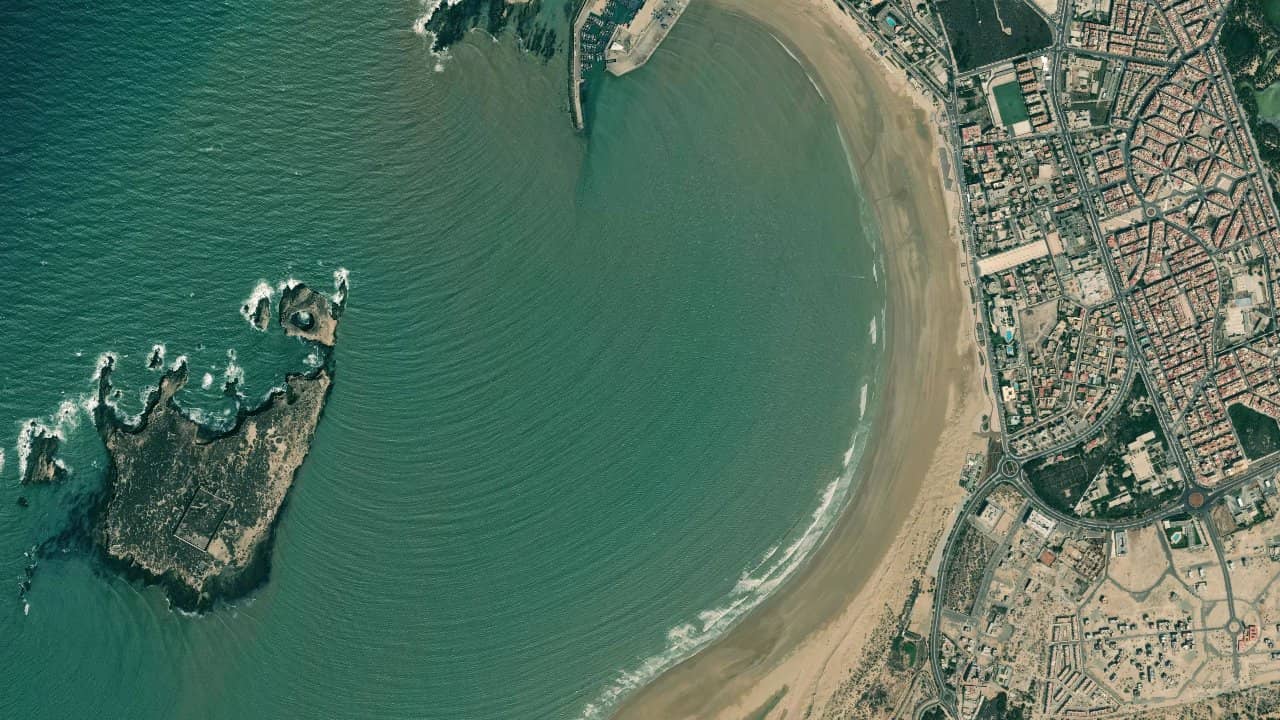
Essaouira is one of the jewels of kitesurfing in Morocco. Its crescent-shaped bay, lined with golden dunes and the ramparts of the UNESCO-listed medina, offers a unique backdrop. It is a place where history, culture, and wind blend together. The trade winds blow here almost all year round, making this resort a world-renowned spot. Local schools, surfers, camels on the beach, and gnaoua music create a lively and bohemian atmosphere. Kitesurfing here means gliding in front of the medina, under golden light, in a perfect mix of exoticism and adrenaline.
The wind data shown here comes from ERA5 (via Open-Meteo) over 4 years, reprocessed to reflect realistic conditions.
👉 Average wind has been calibrated to avoid the usual underestimation of models.
👉 Gusts have been corrected by a median ratio to avoid unrealistic extreme values.
👉 Each day is summarized by the median wind (P50) observed during useful hours (8am–8pm), then classified into wind ranges.
👉 The weighted mode mixes average wind and gusts to best reflect felt wind.
Essaouira bay offers a varied water plan: choppy near the shore, gentle swell offshore, and a constant side-onshore wind from north to northeast. It is an ideal spot for freeride and wave riding, but also for progressing safely. At low tide, the sea recedes significantly, revealing a large sandy area. At high tide, waves form closer to the shore, creating beautiful natural ramps. Riders appreciate the power of the wind and the vast space to navigate freely. The atmosphere is sporty yet relaxed, and safety is ensured by several well-established schools on the south beach.

Wind side-onshore from north to northeast, between 18 and 28 knots, steady, warm, and perfectly oriented for freeride and surfkite.
Water conditions are choppy to moderately wavy depending on swell and tide. Waves range between 0.5 and 2 m. The bottom is sandy, with no significant reef or rocks. The water becomes cleaner and more stable as you move away from the shore.
Currents are generally weak, oriented southward during high tide. No particular danger, but a slight drift may be felt during high tide sessions. Overall, the spot is very safe.
In summer, riders mainly use kites of 6 to 9 m². In winter or during light wind, 9 to 12 m² are suitable. The wind gradually increases during the day, allowing the same kite size to be used for several hours.
The prevailing wind blows from the north to northeast between 15 and 30 knots, depending on the season. It starts in the late morning and peaks between 1 PM and 6 PM. In summer, it can be powerful and consistent for several days in a row. In winter, the wind is present but less strong, perfect for larger kites. The sun shines on average 320 days a year, with stable and predictable conditions.
Moderate and windy oceanic climate all year round. Temperatures range between 20°C and 28°C depending on the season, with very little rain. The air remains humid but pleasant, refreshed by the Atlantic breezes. Winters are mild and summers are perfectly breezy. The thermal wind often reinforces the trade winds in the afternoon, ensuring a steady flow from March to October.
Between 1 and 2.5 meters depending on the tide. Homogeneous sandy bottom with no obstacles.
Between 17°C and 22°C depending on the season. A thin full suit (3/2) is recommended outside of summer, while a shorty is sufficient from June to September.