France
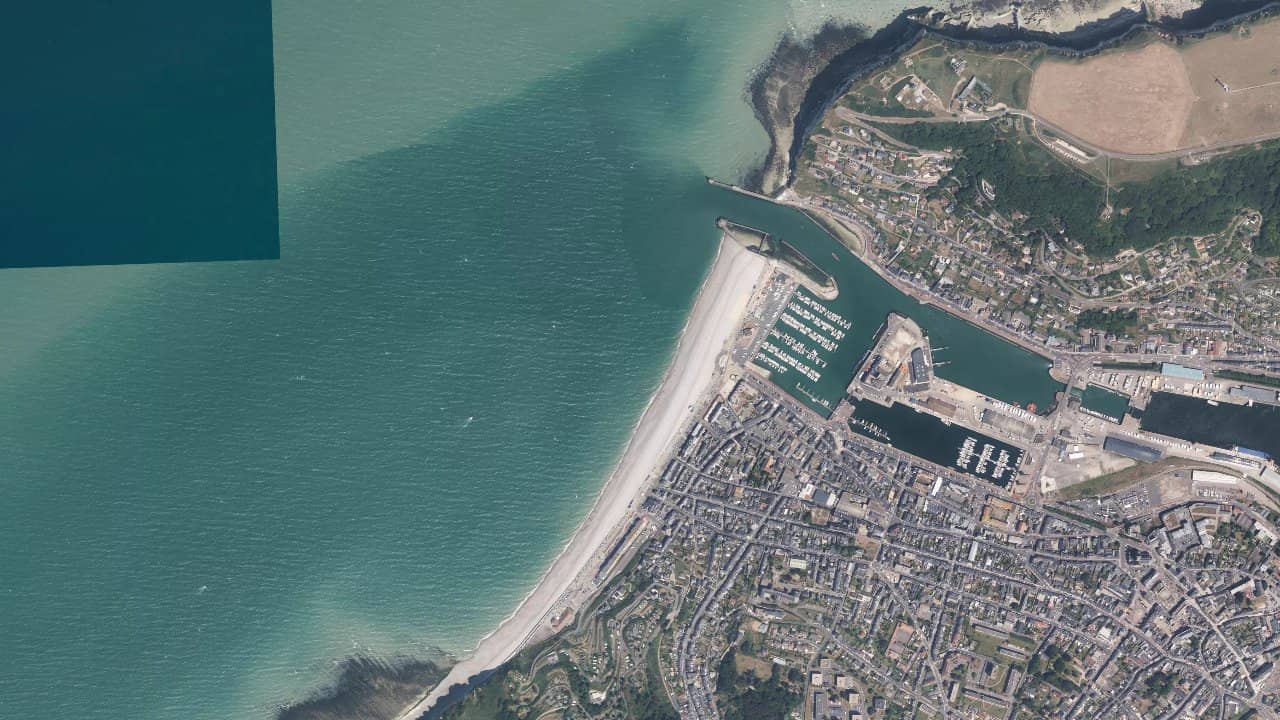
Nestled between the high cliffs of the Alabaster Coast and dominated by its port breakwaters, the Fécamp beach is an urban spot with a strong character. Composed mainly of pebbles, it offers a decidedly maritime navigation in a spectacular setting, blending white cliffs, an active port, and an open horizon over the English Channel. This is not an easy or forgiving spot, but it can offer great committed sessions when the wind and tide are well aligned, mainly for independent and experienced riders.
The wind data shown here comes from ERA5 (via Open-Meteo) over 4 years, reprocessed to reflect realistic conditions.
👉 Average wind has been calibrated to avoid the usual underestimation of models.
👉 Gusts have been corrected by a median ratio to avoid unrealistic extreme values.
👉 Each day is summarized by the median wind (P50) observed during useful hours (8am–8pm), then classified into wind ranges.
👉 The weighted mode mixes average wind and gusts to best reflect felt wind.
Navigation takes place in open sea, in immediate proximity to the port and breakwaters. The spot is highly dependent on the tide: at low tide, launching is technical due to the pebbles and steep slope, while at high tide the depth quickly becomes sufficient but the space at the shore is very limited. The dominant wind blows from west to northwest, arriving side to side-onshore. The water conditions are generally choppy to rough, with waves sometimes disorganized under the influence of port structures.
Wind from west to northwest, side to side-onshore, between 15 and 25 knots, with a well-anticipated tide.
Water conditions are choppy to rough, rarely clean. The waves are short and sometimes messy, offering demanding navigation that is not well suited for flat water or progression.
Currents present and sometimes strong, directly linked to the tide and port configuration. Drift can be rapid during spring tides, requiring constant vigilance.
The most commonly used kite sizes range from 7 to 11 m² depending on the rider's size and wind strength. Smaller kites are common during well-winded episodes.
Dominant wind from west to northwest, often strong, with typical intensities between 15 and 25 knots. The cliffs and breakwaters can generate site effects, with wind sometimes irregular or gusty near the shore.
Cool and windy oceanic climate, typical of maritime Normandy. Summers are mild and bright, while winters are cold, damp, and exposed to Atlantic depressions. The spot is navigable for a large part of the year, with a more comfortable window from spring to autumn.
Depth quickly varies with the tide, with deep areas very close to the shore at high tide.
Water temperature ranges from 8–10°C in spring to 17–20°C in summer. A full wetsuit is recommended for most of the year.