Émirats arabes unis
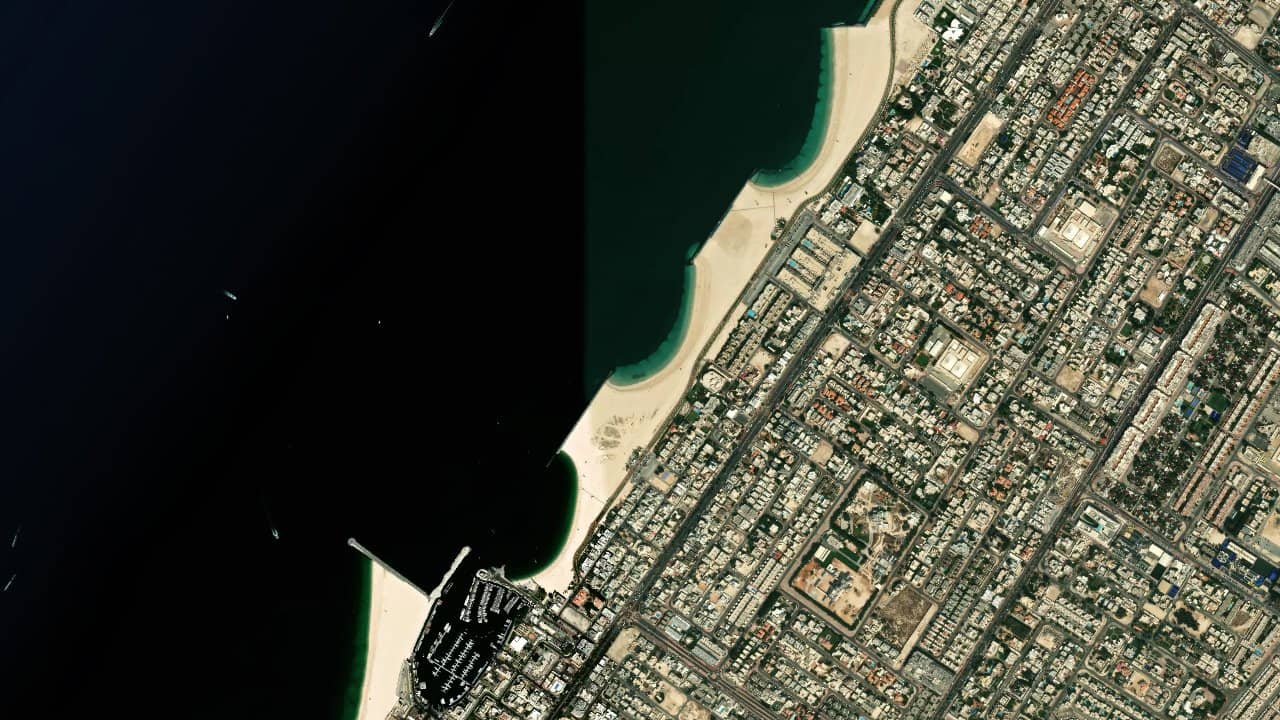
NessNass Beach, in Dubai, is an easily accessible spot well-known by local riders. The beach offers space to prepare equipment, with direct access from the parking lot and a calmer atmosphere than some other areas of the city.
The spot is appreciated for its practicality and for its water surface accessible to a wide range of skill levels, even if the conditions often remain modest in wind. It is mainly visited for a simple session, in an urban yet pleasant setting, with a real kite culture around Kite N Surf.
Les données de vent affichées ici proviennent d’ERA5 (via Open-Meteo) sur 4 ans, retraitées pour refléter des conditions réalistes.
👉 Le vent moyen a été calibré pour éviter la sous-estimation habituelle des modèles.
👉 Les rafales ont été corrigées par un ratio médian afin d’éviter des valeurs extrêmes irréalistes.
👉 Chaque jour est résumé par le vent médian (P50) observé pendant les heures utiles (8h–20h), puis classé dans des plages de vent.
👉 Le mode pondéré mélange vent moyen et rafales pour refléter au mieux le vent ressenti.
NessNass Beach mainly works with wind from the NE to E, often more interesting when it is clean and consistent. According to available feedback, the orientation is generally side-shore to side-on depending on the exact wind axis, which remains exploitable for safe navigation. The spot is rather suitable for beginners to intermediate, as the navigation area is relatively clear and the beach allows for simple entry.
The water surface is described as flat to slightly choppy, with a weak to negligible tide influence on navigability. Sources converge to say that the spot remains tide independent, so one can sail there without real tide constraints. The takeoff area is medium to large, but one must stay organized as the beach can accommodate schools, swimmers, and other local users.
In practice, one often sails offshore from the swimming area, with particular attention to the edges of the spot. The breakwaters and local traffic areas require keeping a margin during edges. The spot is more comfortable when the wind is established and consistent, as soft days quickly lead to an underpowered session.

The best sessions occur with a wind from W to N, well-established and fairly consistent. The spot becomes interesting when the wind rises in a range of 15 to 20 knots, as this allows for more serene navigation without being at the limit of light wind.
At this spot, one mainly seeks clean, stable wind that is not too gusty. Days when the direction remains well-oriented relative to the beach offer the simplest and most pleasant conditions.
The water surface is mainly flat with light chop when the wind strengthens or becomes a bit irregular. Specialized sources describe a spot in shallow to medium water depending on the area, with overall simple navigation for working on edges and transitions.
This is not a wave spot. People mainly come here for an easy water surface, practical entry, and accessible navigation, even if the attendance can require vigilance around schools and other users.
The area is considered not very tide-dependent, which simplifies session organization. The current is generally not the dominant factor of the spot, but one must remain attentive near areas close to the shore and coastal structures.
Tides have little effect on the overall quality of sailing, but they can influence the comfort of entering and exiting the water depending on the chosen area. Therefore, a safety margin is maintained during takeoff and landing.
The most suitable sizes often revolve around 10 to 14 m² for the majority of riders, with larger kites on lighter days. Local sources often mention 10-11 m, 12-13 m, and 14 m and more when the wind is light.
With your wind data at 18.9 knots, a kite of 9 to 11 m² will often be the right starting point depending on the size and level. Lighter riders may go a bit smaller, while heavier riders will stick to 11 to 12 m².
The useful wind at NessNass Beach most often comes from the NE to E, with variations depending on the regional weather situation. The consulted data indicates a spot that works well under moderate regimes, without being known for extremely strong and consistent wind.
On the best days, the wind stabilizes around an exploitable range for kiting, with values often around 12 to 19 knots. The spot is therefore interesting when the breeze is clean, but it remains sensitive to irregular or too weak days.
The climate of Dubai is hot and dry for a large part of the year. The most pleasant months for kiting are generally winter and early spring, with more bearable temperatures and air that is often more breathable than during the summer.
From February to May, conditions are often the most interesting for sailing, with heat still manageable and more exploitable wind windows. In summer, the heat becomes very intense and humidity can make sessions less comfortable, even if the wind can still pick up on some days.
The depth is described as shallow to medium depending on the area, with fairly gradual access. The bottom is mainly sandy, which facilitates entry and reassures progressing riders.
However, one should remain vigilant near coastal development areas and the edges of the spot. Navigation remains simpler in the main axis of the water surface, where the space is most open.
The water remains generally warm for a large part of the year in Dubai. In winter, it can feel a bit cooler, but it is generally navigable without a thick wetsuit.
In spring and autumn, the water temperature is most often very pleasant, making these periods comfortable for long sessions. In summer, the water becomes very warm, to the point of making outings almost too warm for some riders.