Émirats arabes unis
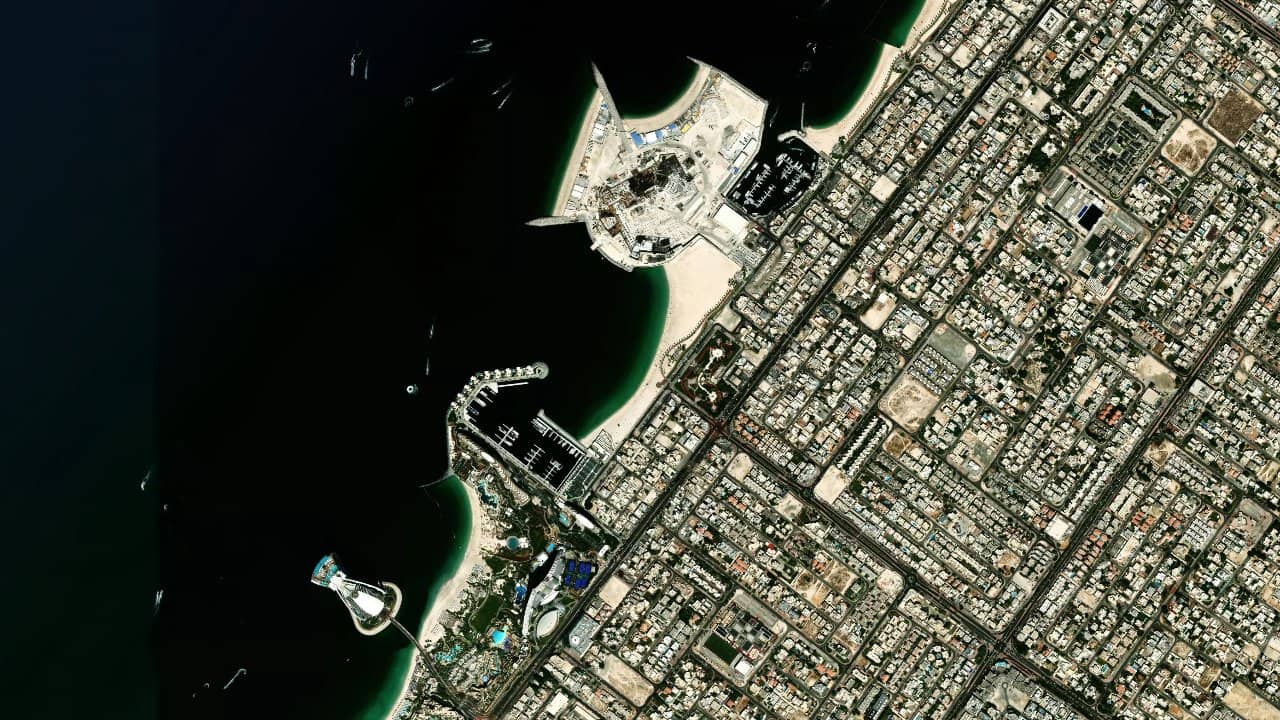
Jumeirah Beach, in Dubai, is a very well-known urban spot for local riders due to its easy access and lively atmosphere. The area mainly attracts kitesurfers who want to ride in a simple setting, with a wide beach and nearby services.
The spot works best when the wind is well established along the coast, with generally more interesting conditions from spring to autumn. It is a practical spot for a short session or for riding without leaving the city.
Les données de vent affichées ici proviennent d’ERA5 (via Open-Meteo) sur 4 ans, retraitées pour refléter des conditions réalistes.
👉 Le vent moyen a été calibré pour éviter la sous-estimation habituelle des modèles.
👉 Les rafales ont été corrigées par un ratio médian afin d’éviter des valeurs extrêmes irréalistes.
👉 Chaque jour est résumé par le vent médian (P50) observé pendant les heures utiles (8h–20h), puis classé dans des plages de vent.
👉 Le mode pondéré mélange vent moyen et rafales pour refléter au mieux le vent ressenti.
Jumeirah Beach most often works with a wind from the NW to W sector, which generally provides a side-shore to side-on wind depending on the exact orientation of the flow. This is the most exploitable type of wind along this stretch of coast, as it allows for clean navigation along the beach without too much constraint at launch. Field reports and local schools describe a spot that is quite accessible, with a practical launch area and ample space on the sand for rigging and taking off.
The water is most often choppy with a small sea swell if the wind takes an angle and gains strength. On weaker days, the water can become smoother near the shore, but one rarely stays on a perfect flat. Navigation generally occurs offshore from the swimming area, keeping a margin from swimmers, paddlers, and other beach users. The spot is more comfortable when the crowd decreases and when the wind is steady, as the launch and landing space then remains easier to manage.
The tide has little influence on the possibility of riding, but it can slightly change the useful width of the beach and the quality of the beach edge. The spot remains generally navigable for a large part of the tide cycle, with a launch area that mainly requires careful observation of the crowd, water lines, and exit corridors. For an autonomous rider, it is a pleasant spot as long as one remains attentive to the urban environment and the density of people on the sand.

The best sessions occur with a NW to W wind, clean, fairly steady, and ideally around 15 to 20 knots. It is in this configuration that the spot becomes most enjoyable, with enough power to ride without straining and enough stability to maintain a good upwind performance.
The most interesting months seem to be February, March, and May, with good chances of finding a usable breeze in the late afternoon. For a rider looking for a simple and effective session, this is the type of wind to expect here.
The water state is most often choppy, with sometimes a small short swell when the wind picks up. When the breeze is steady, the water becomes more readable and comfortable for upwind riding, but it is not an absolute flat spot. Specialized guides and local schools describe a spot suitable for simple navigation, with no major surprises on the water.
Depending on the wind strength, the water can alternate between a slightly rippled sea and a more pronounced chop. The beach edge generally remains manageable, but one must deal with the crowd and variations in water texture related to the wind and tide.
Currents are generally weak to moderate in this coastal area, but one must remain vigilant near passage and coastal navigation zones. The tide can slightly alter the dynamics near the shore, without generally creating very strong currents along the entire beach.
The main point of attention remains space management, especially if one is riding close to the shore or in a busy area. The spot does not read like a strong current spot, but it requires maintaining clean trajectories and closely monitoring the downwind drift.
With the usual wind at the spot, the most useful sizes are often between 9 and 12 m² for the majority of riders. When the wind drops a bit, it can be useful to switch to 12 to 14 m², especially for heavier riders. When the shamal or a good thermal breeze sets in, kites around 7 to 9 m² may suffice.
To cover most days at Jumeirah Beach, a reasonable quiver would be 7, 8, 9, 10, and 11 m², with a larger kite if you are traveling light and mainly expecting moderate winds.
The wind in Dubai is mainly related to thermal breezes and certain episodes of desert wind. At Jumeirah Beach, the beach often receives a usable flow from the NW or W sector, with intensities frequently around 10 to 20 knots depending on the season and time of day. Several reports from practitioners indicate that the best windows often occur in the afternoon, when the sea breeze really sets in.
The most interesting months are often February, March, and May for the balance between temperature and wind. Episodes of shamal, a stronger northwesterly wind, can offer better sessions, but they are not systematic. The wind remains quite irregular from day to day, with excellent days followed by very light days.
The climate in Dubai is hot and dry for a large part of the year, with very high temperatures in summer and more bearable conditions between October and May. Local sources and spot guides indicate that the most pleasant time to ride is during the cooler months, when the air often hovers around 25 to 30°C.
In summer, the heat quickly becomes intense and humidity can make sessions more challenging, although the wind can sometimes pick up in the late afternoon. The water remains warm for a large part of the year, which often limits the use of neoprene to a strict minimum. In winter, comfort is much better on the beach, with still very mild days for kitesurfing.
The depth increases gradually and the bottom is generally sandy. One can usually stand within a useful distance near the shore, which facilitates launching and the first meters of navigation. This is a real positive point for a very busy urban spot.
The beach allows for easy preparation of the kite, but one must keep in mind that the launch area can be shared with other activities. The sandy bottom limits unpleasant surprises, and the reading of the spot remains quite simple for an autonomous rider.
The water is warm almost all year round in Dubai, with very comfortable temperatures in spring and autumn. Local feedback often reports water around 22 to 26°C during the good season, allowing for riding in a light shorty or lycra depending on individual sensitivity.
In summer, the water becomes even warmer and neoprene generally becomes unnecessary. In winter, it remains relatively mild compared to many other kitesurf destinations, making the spot pleasant even off-season.