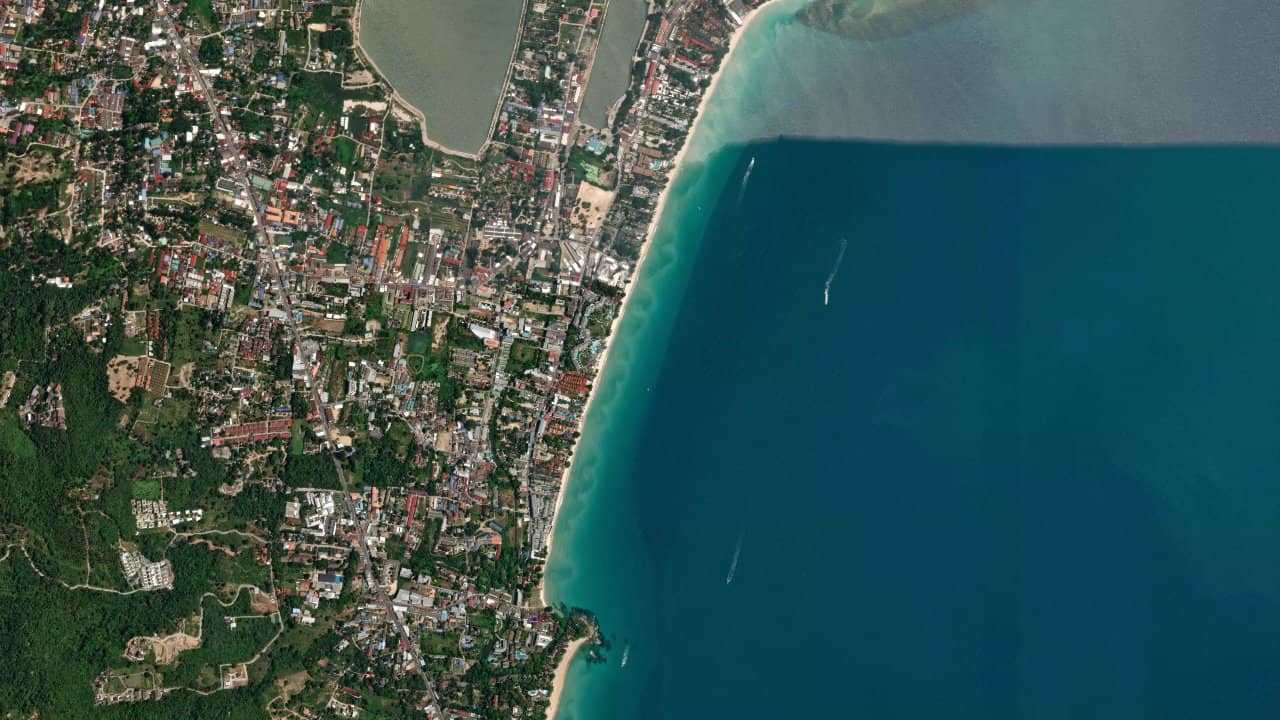
Koh Samui - Chaweng Beach
Thaïlande
Koh Samui
Chaweng Beach is the most famous and busiest beach in Koh Samui, located on the east coast of the island. It is a beautiful stretch of 7 kilometers of white sand that offers enough space for takeoff and landing despite a moderate width. The beach borders the tourist village of Chaweng, with all the necessary services and infrastructure for kitesurfers.
The spot is appreciated for its accessibility and cosmopolitan atmosphere. Although very crowded in high season, Chaweng remains a must-visit destination for riders seeking consistent conditions and a well-equipped environment.
Les données de vent affichées ici proviennent d’ERA5 (via Open-Meteo) sur 4 ans, retraitées pour refléter des conditions réalistes.
👉 Le vent moyen a été calibré pour éviter la sous-estimation habituelle des modèles.
👉 Les rafales ont été corrigées par un ratio médian afin d’éviter des valeurs extrêmes irréalistes.
👉 Chaque jour est résumé par le vent médian (P50) observé pendant les heures utiles (8h–20h), puis classé dans des plages de vent.
👉 Le mode pondéré mélange vent moyen et rafales pour refléter au mieux le vent ressenti.
- 🟢 10–16 nds : vent faible mais navigable (notamment en foil).
- 🟡 16–22 nds : plage idéale, conditions confortables pour la majorité.
- 🔴 22–28 nds : vent fort, réservé aux riders expérimentés.
- 🟣 28+ nds : conditions extrêmes, navigation engagée.
Localisation & Points d'intérêt
Informations utiles
Chaweng Beach primarily operates during the northeast monsoon (November to February), when the winds are most stable and regular. The wind arrives in side-shore to side-onshore orientation, creating acceptable conditions for progression. The water is generally choppy with small waves, creating a dynamic yet accessible water surface.
Entry is easy from the beach, with a gradual depth. The spot offers variable conditions depending on the tide: at low tide, the water surface may be flatter, while at high tide, the small waves are more pronounced. The beach stretches along its entire length, allowing riders to find different wind angles depending on their position. Typical winds range from 8 to 20 knots during the main season, with gusts reaching up to 25 knots in optimal conditions.
Outside of the NE season (March to October), the spot becomes very weak with light and irregular winds, making practice difficult. Summer conditions (May-October) bring stronger southwest winds to the west coast of the island, leaving Chaweng in a relatively sheltered area.

The ideal conditions at Chaweng Beach occur during the northeast monsoon, from November to February. The optimal winds blow from the NE to E with a strength of 14 to 18 knots, creating perfect side-shore conditions for progression. These winds are stable and regular, without excessive gusts, allowing for safe and progressive practice.
The best sessions occur in the late morning and early afternoon when the wind fully establishes. Days with a slight swell from the southwest combined with northeast winds offer the best overall conditions for kitesurfing.
The water surface at Chaweng Beach is characterized by choppy conditions with small waves during the main season. The water is never truly flat, providing a dynamic yet accessible environment for riders of all levels. The waves mainly come from local swells generated by the wind rather than distant swells.
At low tide, the water surface becomes more choppy with shorter and closer waves. At high tide, conditions soften slightly with more regular waves. The water temperature remains very warm year-round, around 28°C, creating a comfortable environment for practice.
The currents at Chaweng Beach are generally moderate and predictable. During the northeast monsoon, the main current follows the coast southward, created by the action of waves and wind. The intensity of the current varies with the tides, being more pronounced at high tide.
It is important to monitor areas of potential rip currents, particularly near areas where water accumulates. These currents can be dangerous for inexperienced riders. The tide in Koh Samui is semi-diurnal with a moderate tidal range, influencing depth and navigation conditions.
For typical conditions at Chaweng Beach during the main season, recommended kite sizes vary according to the rider's weight and the day's conditions. With winds of 12 to 20 knots, lighter riders (under 70 kg) will use kites of 11 to 13 m², while heavier riders will prefer kites of 14 to 17 m².
For days of light wind (8-12 knots), larger kites of 15 to 19 m² are necessary. Experienced riders can also use smaller kites (9-11 m²) on strong wind days (18-25 knots). It is recommended to have at least two kites to cover the full range of seasonal conditions.
The wind regime at Chaweng is dominated by two distinct monsoons. The northeast monsoon (November to February) is the main season, bringing regular and dry winds from the NE, E to SE. These winds are stable and predictable, with an average strength of 12 to 20 knots, ideal for practice.
The southwest monsoon (May to October) mainly affects the west coast of the island. Chaweng, exposed to the east, receives much weaker and more irregular winds during this period, making the spot unreliable. The winds can be variable and light, often insufficient for kitesurfing.
Koh Samui enjoys a warm tropical climate year-round. The air temperatures range between 28 and 32°C on average, with high humidity characteristic of southern Thailand. The dry and cool season (November to February) offers the most pleasant conditions, with slightly lower temperatures and less humidity.
The rainy season (May to October) brings regular showers and oppressive humidity, although the rainfall is generally short and intense rather than persistent. This period also corresponds to the potential tropical storm season, making navigation less predictable.
The depth at Chaweng Beach is gradual and regular, with a fine sand bottom providing excellent conditions for practice. From the shore, one can stand up to about 50 meters from the beach, allowing for easy and safe entry even for beginners.
At low tide, the depth decreases but remains sufficient for comfortable navigation. At high tide, the water rises gradually without creating dangerous areas. The sandy bottom is ideal for falls, minimizing the risk of serious injuries.
The water at Chaweng Beach remains very warm year-round, with temperatures ranging between 27 and 29°C. During the main season (November to February), the temperature is around 28°C, offering maximum comfort for practice without a wetsuit.
Even in the hot season (May to October), the water never drops below 27°C. A simple rash vest is recommended for UV protection rather than for warmth. The thermal conditions are ideal for riders looking to minimize protective gear.