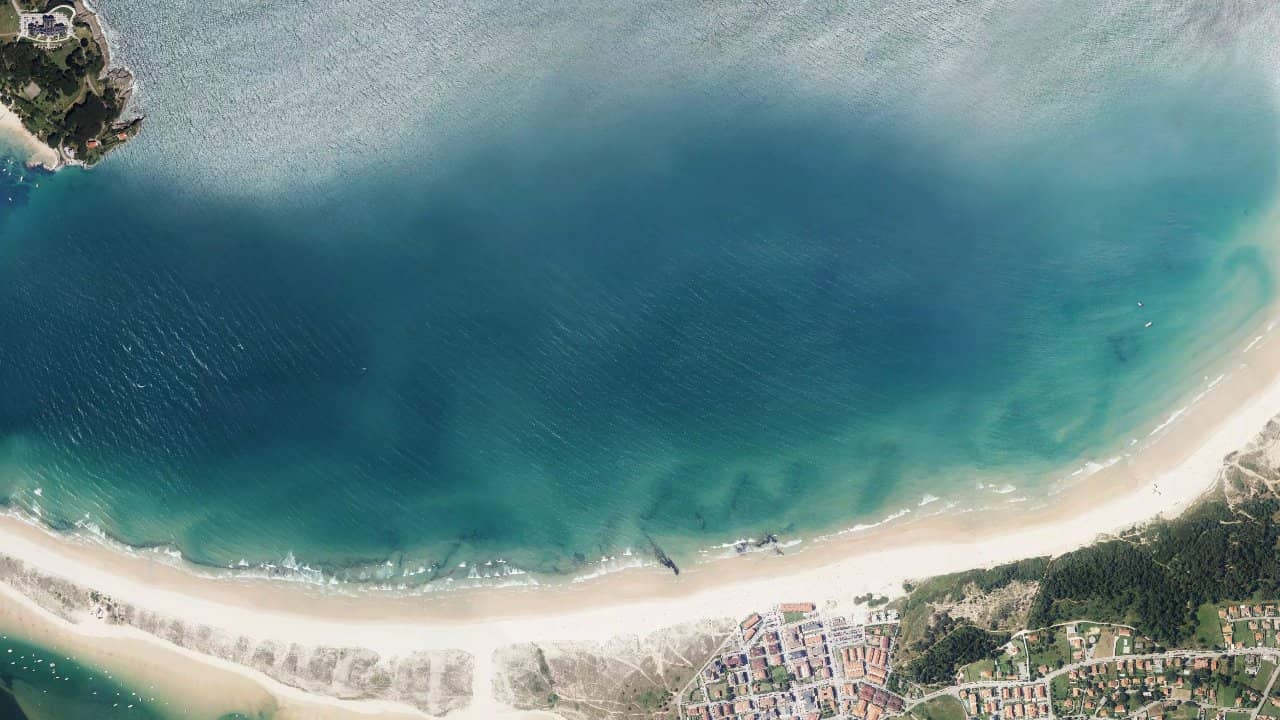
Somo - Playa de El Puntal
Spain
Somo
The Playa de El Puntal in Somo, Cantabria, is a vast sandbar over 4 kilometers long that closes the bay of Santander to the south. It offers stunning views of the city from its north side exposed to the Cantabrian Sea.
The northern part features a strong swell while the southern side, in the bay, remains calm and shallow. It is a popular spot for its length and wild character, accessible on foot from Somo or by boat in summer.
Nudism is practiced in certain areas, especially near the central dunes, and the atmosphere is relaxed with a clean and wide beach.
Les données de vent affichées ici proviennent d’ERA5 (via Open-Meteo) sur 4 ans, retraitées pour refléter des conditions réalistes.
👉 Le vent moyen a été calibré pour éviter la sous-estimation habituelle des modèles.
👉 Les rafales ont été corrigées par un ratio médian afin d’éviter des valeurs extrêmes irréalistes.
👉 Chaque jour est résumé par le vent médian (P50) observé pendant les heures utiles (8h–20h), puis classé dans des plages de vent.
👉 Le mode pondéré mélange vent moyen et rafales pour refléter au mieux le vent ressenti.
- 🟢 10–16 nds : vent faible mais navigable (notamment en foil).
- 🟡 16–22 nds : plage idéale, conditions confortables pour la majorité.
- 🔴 22–28 nds : vent fort, réservé aux riders expérimentés.
- 🟣 28+ nds : conditions extrêmes, navigation engagée.
Localisation & Points d'intérêt
Informations utiles
The beach is oriented north-south, with the north side facing the Cantabrian Sea and the south protected in the bay of Santander. Side-on winds from the northwest or west work well on the north side for kitesurfing, while the south is better suited for beginners with its flat water.
Launching is easy everywhere thanks to the fine sand, but prefer the central area for takeoff away from swimming zones. Depending on the tides, the water conditions vary: flat and shallow on the south side at high tide, more chop on the north with waves at low tide. Be cautious of the entrance channel of the bay that separates the two sides.
The best riding areas are along the north beach for freeriders, with enough space for loops and jumps. Locally, riders avoid the ends where the current can trap you towards open sea.
Ideal conditions are winds of 15-25 knots from the NW or W, side-on on the north side for dynamic sessions. Avoid pure onshore from the north which generates too many waves.
On the north side, the water is choppy with regular waves due to exposure to the Cantabrian Sea. On the south side, it is flat and calm, ideal for freestyle.
Conditions vary with the tide: more waves at low tide on the north, smooth water at high tide on the south.
The current is weak in the southern bay, but more pronounced near the entrance channel that connects to Santander. Tides strongly influence: strong outgoing current at low tide on the north side.
Stay in the middle of the beach to minimize the risk of drifting out to open sea.
Opt for kite sizes of 9 to 12 m² on average, 7-9 m² on strong days in winter, and 10-13 m² in summer for the calm south.
The prevailing wind comes from the northwest or west, often side-shore on the north beach, with average strengths of 15-25 knots in season. There is no specific local name, but it is reliable due to the bay's channel effect.
Current forecasts indicate a wind at 244.5° (west-southwest) with a score of 59/100, suitable for a decent session.
The Cantabrian climate is oceanic, with mild temperatures year-round: around 10-15°C in winter and 20-25°C in summer. Rainfall is frequent, especially in autumn, but the summer months offer more stability.
All months are viable for kitesurfing thanks to a steady wind, peaking in winter for more powerful conditions.
The depth is gradual with a completely sandy bottom. You can stand up to 50-100 m from the shore on the south side, less on the north where it drops off more quickly.
The water remains cool: 12-15°C in winter (Jan-Apr), 18-22°C in summer (Jun-Sept). A 5/3 wetsuit is mandatory outside the warm season.