Spain
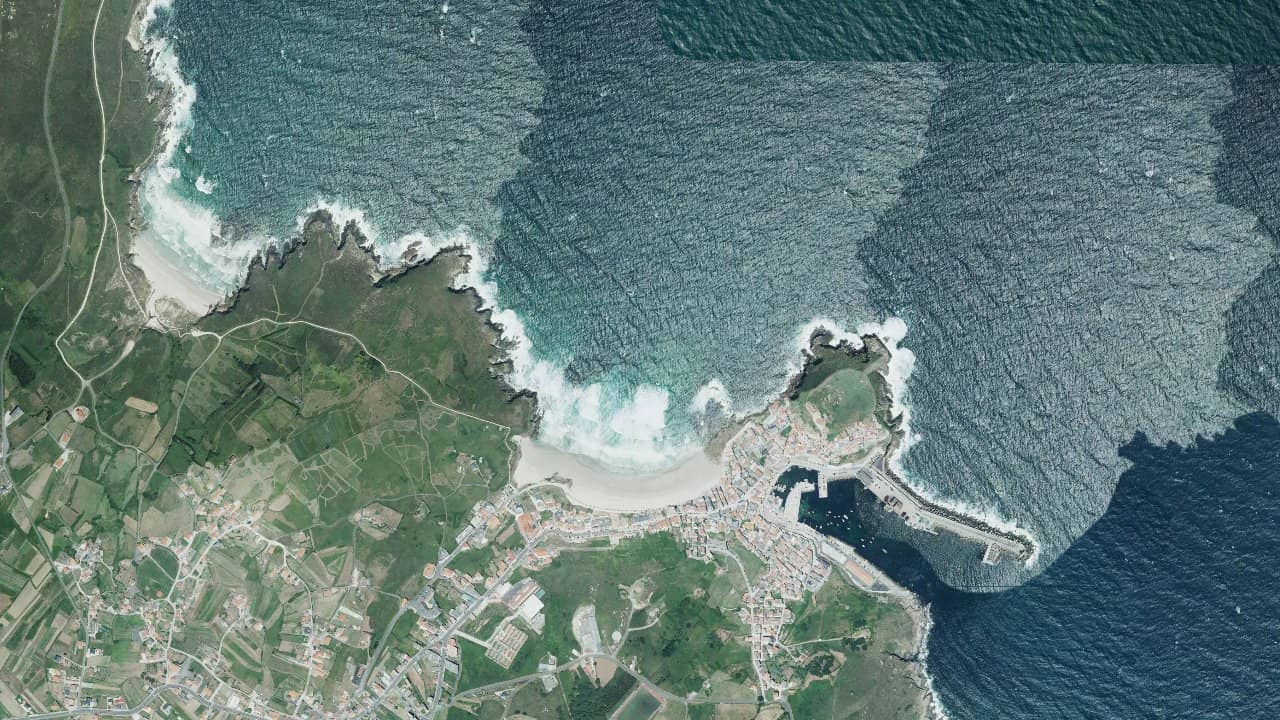
The Area Maior beach in Malpica is located in the heart of the small port town, facing the colorful houses and the fishing port. It is a large sandy bay open to the Atlantic, known to surfers for its consistent waves and its convenient urban setting with all amenities nearby.
For kitesurfing, the beach offers a wide sandy area at low tide and often well-oriented wind for riding along the shore. However, conditions can be challenging with strong swell, featuring powerful waves typical of the northern Galician coast, making it a spot particularly appreciated by intermediate and advanced riders.
Les données de vent affichées ici proviennent d’ERA5 (via Open-Meteo) sur 4 ans, retraitées pour refléter des conditions réalistes.
👉 Le vent moyen a été calibré pour éviter la sous-estimation habituelle des modèles.
👉 Les rafales ont été corrigées par un ratio médian afin d’éviter des valeurs extrêmes irréalistes.
👉 Chaque jour est résumé par le vent médian (P50) observé pendant les heures utiles (8h–20h), puis classé dans des plages de vent.
👉 Le mode pondéré mélange vent moyen et rafales pour refléter au mieux le vent ressenti.
The beach is generally oriented northwest, with the ocean open to the north and northwest. A west sector wind (275°) generally arrives side-shore to side-on from the right when facing the sea, which is comfortable for navigation and maneuvers. Winds from W to SW are often the most practical for kitesurfing, while north winds become more side-on and can make the water surface more chaotic.
The water surface is directly exposed to the Atlantic swell. At low tide and mid-tide, a regular beach break can be found with variable-sized waves depending on the day, from small manageable sets to more serious conditions in case of strong swell. At high tide, the beach shrinks and waves break closer to the shore with a sometimes powerful shorebreak, complicating launching and landing the kite.
The main navigation area is located in front of the large sandy beach, staying well clear of the port and monitored swimming areas in summer. Launching usually takes place from the center or the end of the beach, where the sand is wide and clear. It is best to launch the kite at a good distance from walkers, umbrellas, and buildings along the breakwater, especially on windy days.
The spot works year-round, but the best sessions generally occur outside the peak beach season when the beach is less crowded. The wind can be irregular under the regime of Atlantic depressions, with very windy days followed by calm days. It is important to check the swell forecast as it directly conditions the wave size and the technical level required. In strong north or northwest swell, the waves become deeper and more powerful, making the spot suitable for experienced riders only.
Locally, the beach is also a well-established surf spot, which requires good coexistence in the water. One must stay away from the main peaks frequented by surfers, especially in the center and near the waterfront. Launching and landing can be tricky on windy days due to the urban terrain and buildings that sometimes create turbulence near the breakwater; it is recommended to position oneself on the clearest section of the beach possible.
Ideal conditions for this spot generally occur with a wind from W to NW, side-shore to side-on, between about 18 and 25 knots for most kite sizes. A moderate swell around 0.8 to 1.5 m offers a good compromise between kitesurfing and control, particularly at mid-tide when the shorebreak is less violent. The beach works year-round, but the most pleasant days combine steady wind and clean swell, often in spring and autumn.
The water surface is predominantly waves, with almost permanent Atlantic swell for much of the year. In small swell or transitional periods, softer conditions can be found with waves of 0.5 to 1 m and a slightly choppy surface, ideal for getting started with waves in kitesurfing. As the swell increases, waves can quickly reach 1.5 to 2 m and more, with powerful sets characteristic of this exposed coast.
At low tide and mid-tide, waves break over sandbanks further offshore, leaving some space between the shorebreak and the surf zone. At high tide, the shorebreak becomes more pronounced and waves break closer to the beach, making the exit and return to shore more technical, especially with cross or gusty winds. The water surface is rarely completely flat; even in light wind, there remains at least some chop related to residual swell.
Currents are mainly related to the Atlantic tide and swell. On this open beach, a drift current can be felt along the shore when the swell is well-formed, especially with sets of swell from the north or northwest. This current can gradually drift towards one side of the bay, requiring regular course corrections.
At high and low tide, a slight current perpendicular to the shore may form, but it is generally manageable for an intermediate rider. As with many beach breaks in Galicia, there can be rip currents and back currents between the sandbanks on days of strong swell. They are useful for surfers but can surprise a kitesurfer who is not comfortable in the waves; one must remain vigilant when navigating near the impact zone.
For an average-sized rider (70–80 kg), kitesurfing is most often done with kites between 8 m² and 11 m² depending on wind strength. On days of winter depression with strong winds, a kite of 7–8 m² is often sufficient, or even smaller for lighter riders. In summer, with more moderate winds, kites of 10–11 m² are the most commonly used, while heavier riders may go up to 12 m² on less windy days.
The region is dominated by Atlantic depressions in winter, which bring often sustained winds from the west and southwest, sometimes very strong with the passage of fronts. These situations generate irregular but powerful winds, suitable for smaller kite sizes for experienced riders in the waves. In summer, the wind is more often related to thermal breezes and the general north to northwest circulation on the Iberian Atlantic front, with more moderate but stable values in the afternoon.
The most interesting wind directions for kitesurfing at Area Maior Malpica are generally W, WNW, and NW, which provide side to side-on wind relative to the beach. South sector winds can also be usable but can become more turbulent due to the terrain and buildings around the bay. East winds, on the other hand, are often offshore or side-off and not well-suited for kitesurfing, especially with the waves.
The climate of the northern Galician coast is oceanic, with mild and humid winters and moderate summers. In winter, air temperatures often hover around 10–14 °C during the day, with frequent Atlantic disturbances and rain. In summer, temperatures generally range between 20 and 25 °C, with some hotter days but rarely heatwaves due to the influence of the ocean.
Spring and autumn often provide a good compromise between wind, swell, and beach attendance. Clouds and drizzle are common for much of the year, but sunny days can be very pleasant with a feeling tempered by the wind. Overall, it is advisable to wear windproof clothing and a suitable wetsuit, even in summer, as the sea breeze keeps the air quite cool.
The depth is gradual with a completely sandy bottom, typical of an Atlantic beach break. You can stand a good distance from the shore, which is reassuring for maneuvers near the beach, but it is important to keep in mind that the wave impact zone can quickly become deeper as you approach the peak.
There are no reefs or major rocks in the central area of the beach, but some blocks may be present towards the ends or near port structures, which are best avoided. Overall, the bottom is quite safe, but the power of the swell remains the main factor of difficulty.
The Atlantic water in Galicia remains cool year-round. In winter, the temperature hovers around 12–13 °C, necessitating a thick wetsuit of 5/4 mm with a hood, gloves, and booties for long sessions. In spring, the water gradually rises to 14–16 °C, allowing for kitesurfing in a well-equipped 4/3 mm wetsuit.
In summer, water temperatures generally range between 17 and 19 °C, sometimes a bit higher during stable periods, but a 3/2 mm wetsuit is still recommended for comfortable kitesurfing, especially in strong winds. In autumn, the water remains relatively mild at the beginning of the season, around 16–18 °C, before dropping back to winter values.