Spain
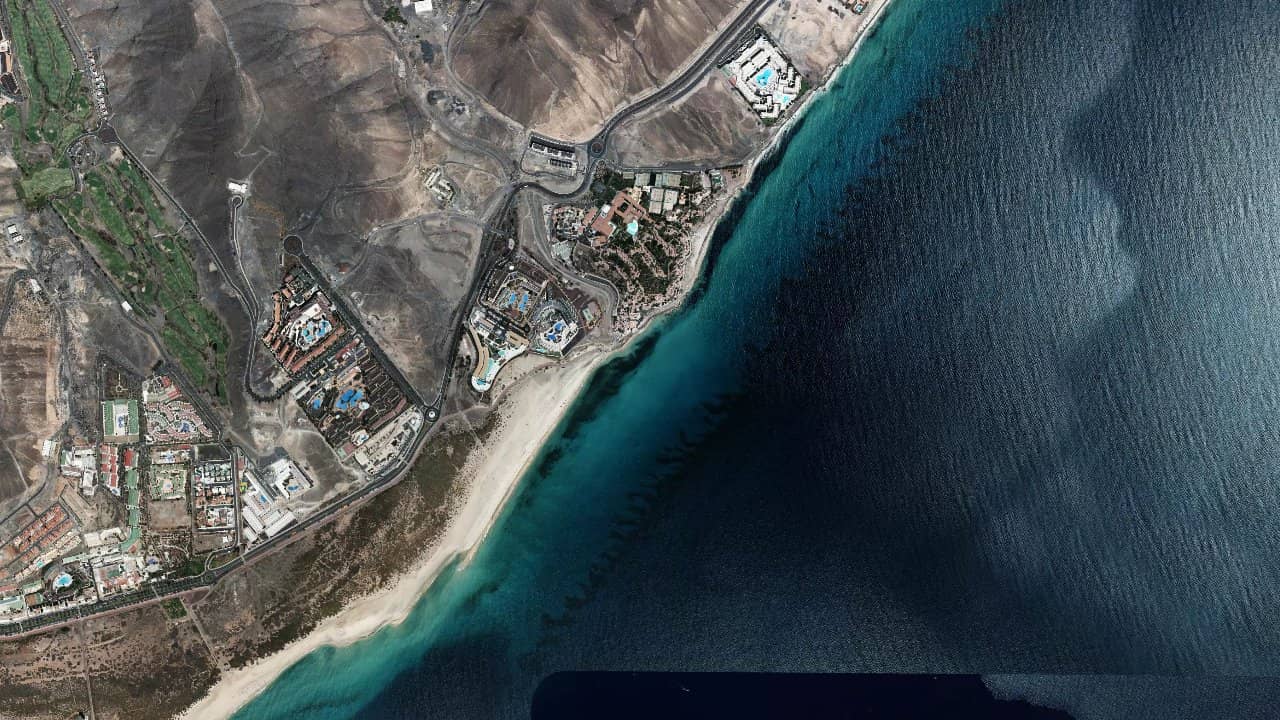
The beach of Piedras Caídas, located at Playa de Jandía in the south of Fuerteventura, is a small stretch of sand and stones wedged between a cliff and the sea. It connects the beach of Butihondo and that of Matorral, with hotels overlooking the area from the heights.
It is a discreet spot protected by its cliffs, away from the crowds of the larger nearby beaches. Locals sometimes visit for its tranquility, even though kitesurfing is not the main activity here.
The spot works best when the wind is strong and offshore, typical of the southern conditions of the island in winter.
Les données de vent affichées ici proviennent d’ERA5 (via Open-Meteo) sur 4 ans, retraitées pour refléter des conditions réalistes.
👉 Le vent moyen a été calibré pour éviter la sous-estimation habituelle des modèles.
👉 Les rafales ont été corrigées par un ratio médian afin d’éviter des valeurs extrêmes irréalistes.
👉 Chaque jour est résumé par le vent médian (P50) observé pendant les heures utiles (8h–20h), puis classé dans des plages de vent.
👉 Le mode pondéré mélange vent moyen et rafales pour refléter au mieux le vent ressenti.
The spot of Piedras Caídas mainly works with strong south or southeast winds, in offshore wind mode that pushes out to sea, ideal for avoiding bathers but to be monitored closely. Launching is done directly from the narrow sandy and stony beach, with a navigation area that opens up to the sea once past the first waves.
The beach is south exposed, so the wind comes side-off or pure offshore when blowing from the south, creating a water surface that can quickly become choppy with chop and short waves near the shore. There is no dedicated launch area, you place the kite on the sand or pebbles, being careful of scattered rocks and the cliff that limits the space upwind.
In summer, the wind is often unstable and thermal, better to go in winter from November to March for more reliable wind. The current can linger near the rocky points, and the absence of rescue services requires being 100% self-sufficient. Tides have little influence on launching, but at low tide, the rocks are more exposed.
The ideal conditions are a south wind at 20-30 knots, stable and offshore, in winter to avoid the crowds and enjoy a navigable water surface.
The water state is often choppy with short waves due to the southern exposure, becoming more agitated when the southern swell rises. Near the shore, a break can form with strong wind, to be negotiated when launching.
Currents are generally weak along the beach, but they intensify near the rocky points and the channel towards Matorral. Tides are moderate, with a tidal range of about 2 meters, having no major impact on navigation except at low tide when the shore narrows.
Opt for sizes 9 to 12 m² in medium-strong south wind, or 7 to 9 m² when it really picks up to control the gusts.
The wind regime in Jandía is dominated by the thermal breeze during the day, often northeast trade winds in summer, but for Piedras Caídas, it is the strong south wind in winter that activates the spot, with gusts over 25 knots. The local name is the south trade wind, side-off for this orientation.
Fuerteventura enjoys a dry subtropical climate year-round, with mild temperatures ranging from 18°C in winter to 28°C in summer. In the Jandía area in the south, the sea breeze softens the heat, and rainfall is rare, less than 100 mm per year.
The best months for kiting are from November to March, with more stable wind conditions, while in summer the wind is more thermal but capricious.
The depth is gradual with a mixed bottom of sand and rocks. You can stand in the first 20-30 meters, then it drops quickly.
The water temperature ranges from 18-20°C in winter to 22-24°C in summer, with a shorty wetsuit recommended outside the warm season.