Spain
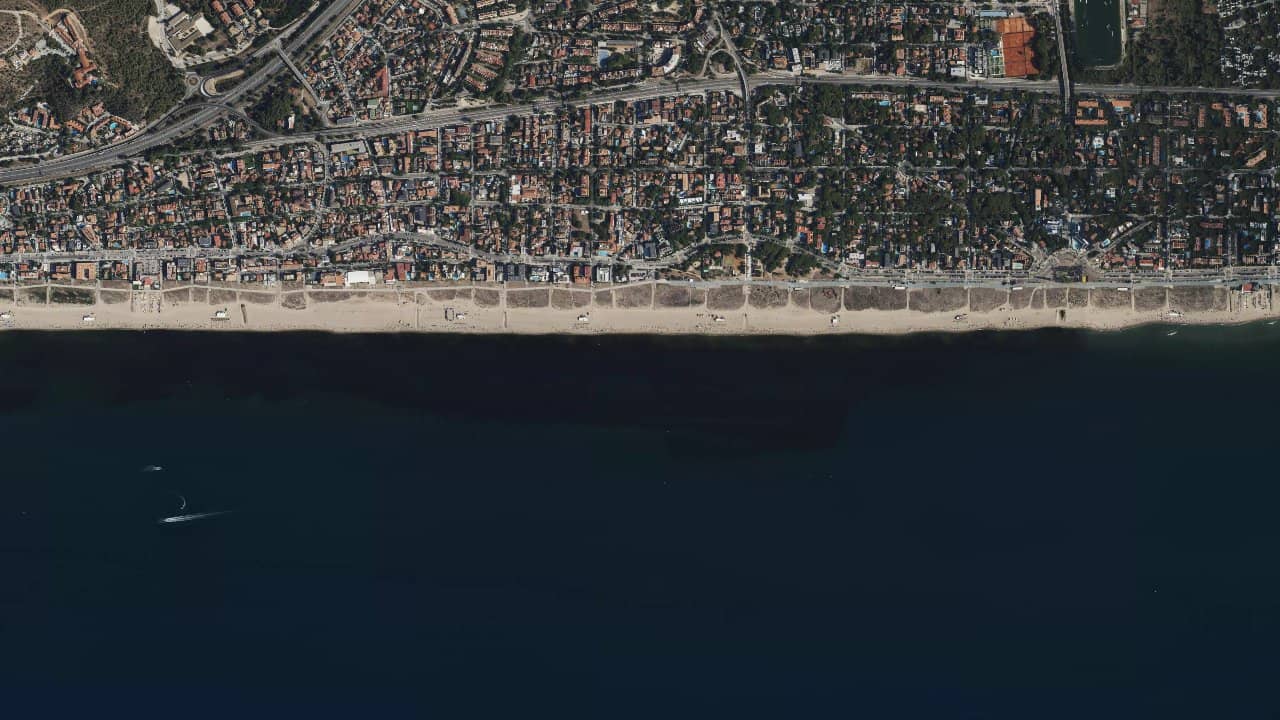
The beach of Castelldefels stretches for several kilometers southwest of Barcelona, with a large sandy strip and a lively promenade in the background. It is a very popular spot among Barcelona riders for its regular thermal wind and easy access by train or car.
Castelldefels is now the main kitesurfing spot in the Barcelona region, with an official kite area marked in summer and several schools set up directly on the beach. The atmosphere is sporty and friendly, with many people on the water as soon as the SW wind picks up.
Les données de vent affichées ici proviennent d’ERA5 (via Open-Meteo) sur 4 ans, retraitées pour refléter des conditions réalistes.
👉 Le vent moyen a été calibré pour éviter la sous-estimation habituelle des modèles.
👉 Les rafales ont été corrigées par un ratio médian afin d’éviter des valeurs extrêmes irréalistes.
👉 Chaque jour est résumé par le vent médian (P50) observé pendant les heures utiles (8h–20h), puis classé dans des plages de vent.
👉 Le mode pondéré mélange vent moyen et rafales pour refléter au mieux le vent ressenti.
The Castelldefels spot mainly works with a SW to W wind, thermal in the afternoon, which usually arrives side-on shore relative to the beach. This wind, often called Garbí or Poniente according to local sources, strengthens on sunny days, especially in spring and early summer, with typical values around 12 to 20 knots in the afternoon.
The water surface is largely chop with small waves. There is tight chop and some ramps when the wind picks up, and small to medium waves with stronger west winds. There is no marked dependence on the tide, the spot works at all water heights, which simplifies session planning.
Launching is done from a wide sandy beach, with plenty of space off-season. In summer, practice is heavily regulated: kitesurfing is only allowed in the official kite zone, about 300 m long, with an exit channel and schedules and permissions to respect from the afternoon until sunset. It is important to inquire about local rules, obtain a permit if necessary, and stay strictly within the marked area.
Outside the summer season, you can generally ride along most of the beach, with a very comfortable launch and landing area. The sand is wide and clear, but in peak season there are many schools, wingfoils, and kites lined up. It is important to organize launches properly, pull up your lines as soon as you come out of the water, and leave a clear corridor for launching.
Directions of NE, N, or NW are much less suitable: more irregular and sometimes offshore, they are not recommended for most riders, especially without a safety boat. On days with east or southeast winds (Levante), the wind can be more side-shore but often more unstable, and it can drop suddenly. The spot remains frequented by all levels, but the crowd and chop require good control of takeoff and heading to navigate calmly in the main area.
The ideal conditions for Castelldefels are a thermal wind from SW to WSW, side-on to the beach, between 15 and 20 knots. With this regime, the water surface presents a regular chop and small waves, perfect for freeride, jumps, and twin-tip.
For beginners and intermediates, a sunny spring or early summer day, with a well-established and stable Garbí, is generally the best setup. More experienced riders will also appreciate days with slightly stronger W winds, which create a more formed water surface.
The water surface of Castelldefels is most often in chop, with short choppy conditions generated by the SW thermal wind. In typical conditions of 12 to 20 knots, there is moderate chop, pleasant for freeride and jumping, without being perfectly flat. On days with stronger winds or swells from W to SE, small to medium waves form at the shore, offering some ramps for surfing or strapless.
The bottom is sandy and the beach slope is rather gentle, which provides a generally manageable shorebreak for intermediate levels. When the wind picks up or a more pronounced swell comes in, the shorebreak can become a bit more physical, but it remains a sandy beach spot, without reefs or large rocks in the usual practice area.
The currents are generally weak in Castelldefels, thanks to the fairly open configuration of the bay and the sandy bottom. There is no marked tidal current, and navigation does not depend on tide schedules.
With sustained SW or W winds, a slight current may set in with the wind direction, which can be noticeable for beginners who struggle to go upwind. Near channels and in front of certain structures (ports or nearby dikes), small water movements can form, but they remain weak for an intermediate rider.
For a rider around 75 kg, the most commonly used kite sizes are generally 9 to 12 m on the classic thermal of 12 to 20 knots. In spring and early summer, a 10 or 11 m covers a large part of the sessions.
In summer, when the thermal is lighter or irregular, it is useful to have a larger kite of 12 to 14 m if you want to maximize time on the water. On days with stronger winds or gusts from the west, a 7 to 9 m kite becomes interesting for experienced riders.
The main wind regime is related to the SW thermal, called Garbí in the region, which sets in around midday when the land heats up. This wind usually comes from SW to WSW, even W, with a typical intensity of 12 to 18 knots in spring and early summer. The hottest days with a clear sky are the most reliable.
In summer, the thermal often blows in a range of 12 to 20 knots, but some days can be lighter and require larger kites. There are also sometimes situations with east or southeast winds, which are more irregular, and episodes of north or northwest winds, which are stronger but often offshore and gusty, thus reserved for very experienced riders and often avoided at this spot.
The climate of Castelldefels is typically Mediterranean, with hot, dry summers and mild winters. In summer, air temperatures often hover around 25 to 35 °C, allowing for riding in a shorty or even in lycra. In winter, temperatures drop to around 8 to 16 °C, with often sunny days but a cooler feel on the water.
The busiest season for kitesurfing runs from April to September, when the thermal wind sets in regularly. However, it is possible to ride year-round whenever the wind is present, with lower attendance in autumn and winter, making the spot calmer but sometimes more technical depending on the wind patterns.
The depth is generally progressive with a sandy bottom. You can stand on a good width near the shore, which reassures beginners and facilitates waterstart exercises. As you move away, the depth increases regularly, without sudden drops known in the usual navigation area.
There are no major reefs or rocks in the standard practice area, but the depth can slightly vary after heavy seas, which can change the shape of the shorebreak and sandbanks.
Water temperature in high season hovers around 21 to 23 °C, allowing for riding in a thin shorty or even in lycra for the more resilient. In spring, the water remains cool at first, often around 16 to 18 °C, and a 3/2 mm wetsuit is comfortable.
In autumn, the sea still retains good thermal inertia, with values close to 20 °C at the beginning of the season, which then gradually decrease. In winter, the water becomes colder, with temperatures around 13 to 15 °C depending on the periods, and a 4/3 mm wetsuit or equivalent is recommended for longer sessions.