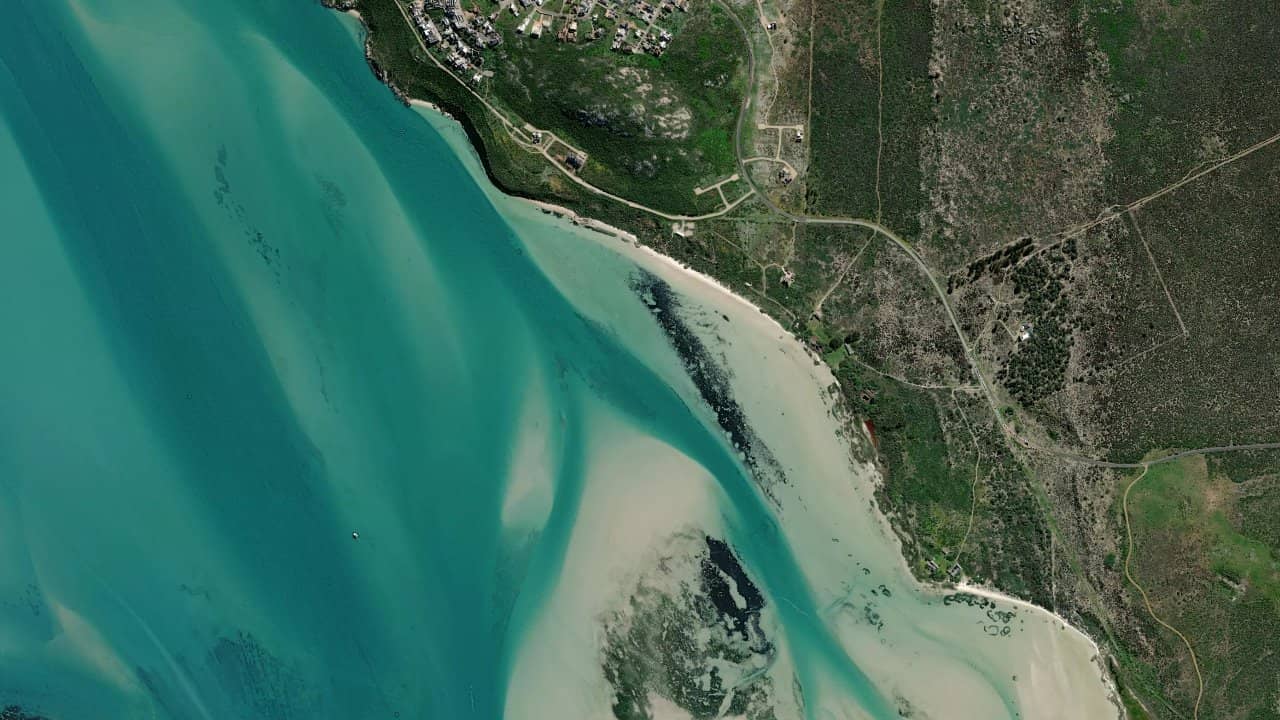
Langebaan - Shark Bay
South Africa
Langebaan
Shark Bay is a beautiful spot in the Langebaan lagoon, in the Western Cape of South Africa. You descend via a winding path from the parking lot at the top of the hill to reach the clear, shallow water. It's a dream place for beginners and those who are progressing, with a preserved natural atmosphere.
The name Shark Bay comes from the harmless little sand sharks, nothing too scary. The water is turquoise clear, warmer than the sea, and the spot is known for its breathtaking beauty. You share the place with a few locals, without too much crowd.
Just a stone's throw from the main beach of Langebaan, Shark Bay offers a peaceful setting, perfect for relaxed sessions away from the ocean waves.
Les données de vent affichées ici proviennent d’ERA5 (via Open-Meteo) sur 4 ans, retraitées pour refléter des conditions réalistes.
👉 Le vent moyen a été calibré pour éviter la sous-estimation habituelle des modèles.
👉 Les rafales ont été corrigées par un ratio médian afin d’éviter des valeurs extrêmes irréalistes.
👉 Chaque jour est résumé par le vent médian (P50) observé pendant les heures utiles (8h–20h), puis classé dans des plages de vent.
👉 Le mode pondéré mélange vent moyen et rafales pour refléter au mieux le vent ressenti.
- 🟢 10–16 nds : vent faible mais navigable (notamment en foil).
- 🟡 16–22 nds : plage idéale, conditions confortables pour la majorité.
- 🔴 22–28 nds : vent fort, réservé aux riders expérimentés.
- 🟣 28+ nds : conditions extrêmes, navigation engagée.
Localisation & Points d'intérêt
Informations utiles
The dominant wind comes from the southeast or south, often side-on relative to the beach, providing good power without too many gusts. At rising tide, the water becomes perfectly flat, ideal for foil or freestyle, while at low tide, the sandbanks reduce the area. The launch is done after a walk of 200-300 meters in waist or chest high water via the main channel.
The navigation area extends over more than 400 meters in the channel before reaching deeper areas, with space to progress without risking the edges. The takeoff is done directly on the soft beach, but be careful of the limited space at high tide. Foilers love calm mornings or light winds for flat butter without whitecaps.
The spot can be a bit windier than the main beach, but less crowded, perfect for going upwind and avoiding beginners clustered elsewhere. In case of strong wind, you can easily find your personal spot in the lagoon.
The ideal conditions are with a side-on southeast wind of 15-25 knots, on rising tide for an absolute flat. Perfect for progression and foil in light morning winds.
The water is clear and shallow, waist or chest high over long distances. Perfect flat at medium/high tide for freestyle and foil, a bit choppy otherwise. No waves thanks to the protected lagoon.
The currents are weak in the lagoon, but more pronounced in the main channel. Tides strongly influence the navigable space, with a notable range that exposes sandbanks at low water.
Opt for sizes of 9 to 12 m² in light to moderate winds, and 7 to 9 m² when it picks up strong up to 30-40 knots. Adjust according to your weight and style.
The wind regime is dominated by the southeast in high season from October to March, with speeds of 20-40 knots and a probability of 95%. In low season from April to September, it blows 10-20 knots with 45% reliability. It's more chill than Cape Town, but consistent for regular sessions.
The climate is Mediterranean with warm summers from November to March and mild, rainy winters from April to October. Temperatures range between 20-30°C in high season and 15-20°C in low season. It's dry and sunny all year round, with a true turquoise paradise in summer.
The depth is gradual, waist/chest high water over 400m+ in the channel, with a soft sandy bottom. Sandbanks everywhere at low tide.
The water is warm compared to Cape Town, around 18-22°C in summer (Nov-Mar) and 14-18°C in winter. A shorty wetsuit is sufficient in high season.