Portugal
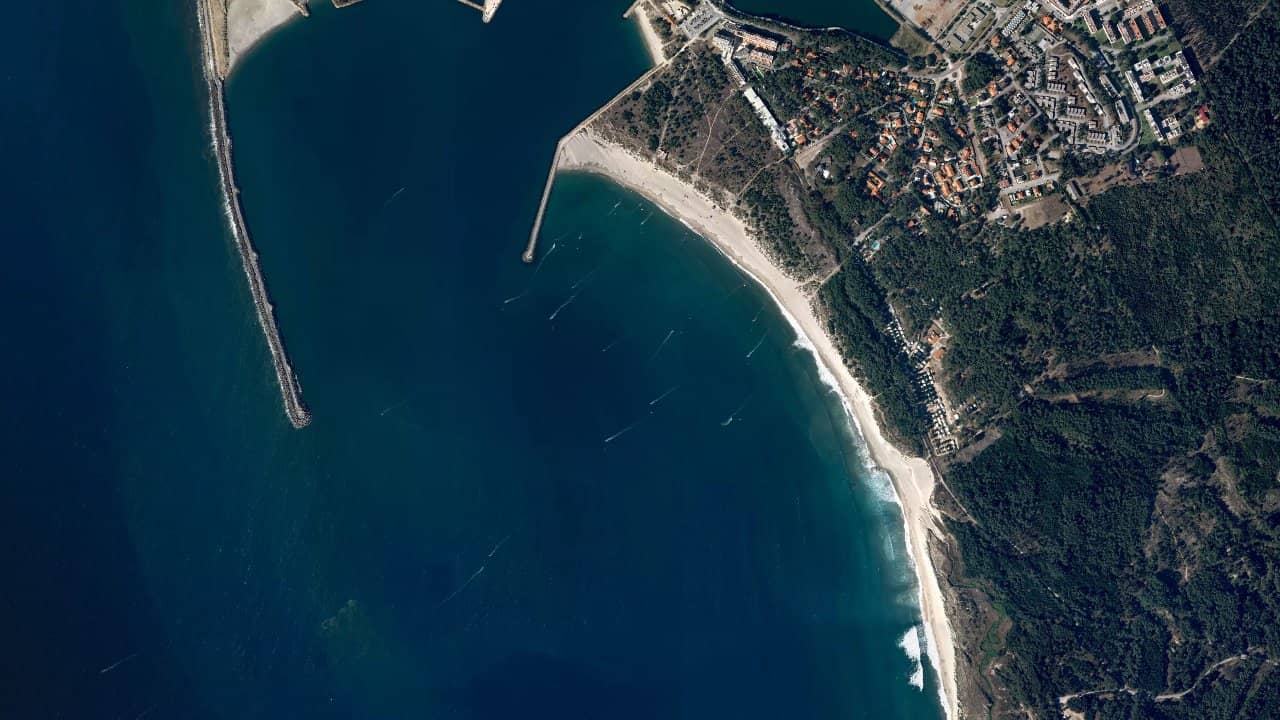
Praia do Cabedelo, south of Viana do Castelo, is a large sandy beach bordered by dunes and pine forests, right in front of the mouth of the Rio Lima. The atmosphere is very oriented towards sliding, with several schools and a constant flow of riders as soon as the thermal wind picks up.
It is an internationally recognized spot that has already hosted stages of the kitesurfing world championship. The beach offers plenty of space, good organization of zones, and a steady wind that attracts both locals and travelers in search of solid sessions.
Les données de vent affichées ici proviennent d’ERA5 (via Open-Meteo) sur 4 ans, retraitées pour refléter des conditions réalistes.
👉 Le vent moyen a été calibré pour éviter la sous-estimation habituelle des modèles.
👉 Les rafales ont été corrigées par un ratio médian afin d’éviter des valeurs extrêmes irréalistes.
👉 Chaque jour est résumé par le vent médian (P50) observé pendant les heures utiles (8h–20h), puis classé dans des plages de vent.
👉 Le mode pondéré mélange vent moyen et rafales pour refléter au mieux le vent ressenti.
The spot is located in a large crescent-shaped bay south of the mouth of the Rio Lima, with a wide and clear sandy beach. The prevailing wind is from the NW sector, generally side-on from the right, making navigation safer, especially for progressing riders. In summer, the wind is a powerful thermal that strengthens from late morning and often reaches high values in the afternoon.
The main kitesurfing area is located to the north of Cabedelo beach, near the jetties and the port, where several centers like FeelViana, North/Duotone clubs, and local schools can be found. The beach is wide there with plenty of space to rig and launch, although in mid-summer it can be crowded and there are reserved zones between bathers, surfers, and kiters. Further south, the beach remains very long, with fewer people and a quieter atmosphere, but services are more distant.
The water surface varies greatly depending on the area. Near the northern jetty and the breakwater, one can find a flatter or slightly choppy area, ideal for freestyle and first runs. Moving further offshore and south, Atlantic waves come in more, with sections of small to medium waves depending on the swell. The spot works at all tides, but the water behavior changes: at low tide, there are more sandbanks, a bit more standing area, and visible rocks in some sectors, while at high tide the beach is narrower and some obstacles may be just below the surface.
Water entry is easy from the sandy beach, but one must keep an eye on the shorebreak when the swell is more pronounced. Schools generally mark takeoff/landing zones and navigation corridors, which facilitates coexistence. The current is influenced by the mouth of the Rio Lima and by the tide, but generally remains manageable for an autonomous rider, especially with the side-on wind pushing towards the shore. In summary, it is a very complete spot, with flat, chop, and waves on the same beach, suitable for all levels as long as one respects the zones and remains vigilant to the rocks and swell.
Ideal conditions for kitesurfing at Praia do Cabedelo are found with a NW to WNW wind, well established and side-on relative to the beach. In these orientations, the water surface is safe, returning to the beach is easy, and the thermal can regularly rise between 20 and 30 knots in summer.
For those seeking wave sessions, a NW wind combined with a west to northwest swell provides very nice surfkite conditions. For freestyle and big air, a strong NW wind with slightly choppy water near the jetty allows for good ramps while keeping relatively smooth areas.
The water surface is very varied depending on the area and swell. To the north, near the breakwater and the jetty, there are flatter or choppy areas, especially when the swell is moderate, which is ideal for freestyle and freeride. Moving further offshore or shifting south, small to medium waves come in, with regular rights when the Atlantic swell is well oriented.
With low swell and strong NW wind, the spot offers well-set chop and flat sections between ramps, interesting for big air and unhooked tricks. With medium to strong swell, it becomes a true wave riding spot for surfkite or strapless enthusiasts, with clean waves offshore from the breakwater and along the beach. The shorebreak can become powerful on certain days, complicating water entry for beginners. Overall, there is a constant mix of flat, chop, and waves, allowing navigation to be adapted to one's level and style.
The currents at Praia do Cabedelo are mainly related to the tide and the influence of the mouth of the Rio Lima located just to the north. The current generally remains moderate in the main kitesurfing area, especially with a NW side-on wind that tends to push towards the shore. However, near the port's exit channel and the jetties, the current can be stronger, especially during tidal changes.
During high coefficient tides, more water movement can be felt, with a slight longitudinal shift relative to the beach. This remains manageable for an autonomous rider, but beginners are advised to stay well within the area supervised by the schools, further south of the port structures, where the current is less pronounced.
With summer winds often between 18 and 30 knots, most medium-sized riders (70–80 kg) usually ride with 7–10 m² kites. On days with moderate thermal winds, a 10–11 m² kite can be very comfortable, while on windier days in July-August, one can easily go down to 7–8 m².
Lighter riders will typically use kites around 6–9 m² in mid-summer, while heavier riders can go up to 11–12 m² at the beginning or end of the season when the wind is a bit less strong.
The wind regime is dominated by the Nortada, a NW sector wind that is thermally reinforced during the day. From May to September, this wind blows almost every day, often between 18 and 30 knots, with stronger gusts on days with well-established thermal conditions. The wind tends to pick up in late morning, strengthen in the afternoon, and weaken in the evening.
Outside the summer season, the wind remains usable but more irregular, often linked to Atlantic depression systems, with sometimes stronger but less predictable gusts. The ideal wind for kitesurfing at Cabedelo is clearly NW side-on, but one can also navigate with orientations close to W or N depending on weather systems, as long as the direction remains sufficiently onshore for safety.
The climate in Viana do Castelo is of a mild oceanic type, with cool and humid winters and moderately warm summers. In winter, average temperatures hover around 10–13 °C, with frequent Atlantic disturbances and more rain. In spring, temperatures gradually rise to around 17–20 °C in May, with already beautiful windy days.
In summer, maximum temperatures are generally around 22–25 °C, rarely scorching due to the influence of the ocean. Thermal breezes kick in almost every day between May and September, offering a very good sailing rate. In autumn, temperatures remain pleasant (often 15–20 °C) but conditions become more variable, with very windy days alternating with calmer periods.
The depth increases gradually with a mainly sandy bottom over most of the spot. You can stand a good distance from the shore, especially at low tide and mid-tide, which is appreciated for learning and maneuvers. Some areas have scattered rocks, but they are generally visible at low tide and well known to local schools.
Offshore, the depth quickly becomes significant with a completely sandy bottom subject to the Atlantic swell. In the main practice area, the combination of a sandy bottom and a gentle slope makes water entry and return to the beach quite comfortable, as long as one remains vigilant to the marked rocks and the shorebreak in case of heavy swell.
The water temperature remains typically cool in this part of the northern Portuguese coast. In winter, it hovers around 13–14 °C, which requires a thick wetsuit (5/4 mm or more) and possibly gloves and booties. In spring, the water gradually rises to 15–17 °C, but a 4/3 mm wetsuit is still recommended.
In summer, the water temperature generally ranges between 18 and 20 °C, sometimes a bit higher during periods without upwelling, allowing for navigation in a 3/2 mm or 4/3 mm wetsuit depending on cold tolerance. In autumn, the water remains relatively mild, often around 17–19 °C, but the air starts to cool down, so a 4/3 mm wetsuit is generally a good compromise.