Portugal
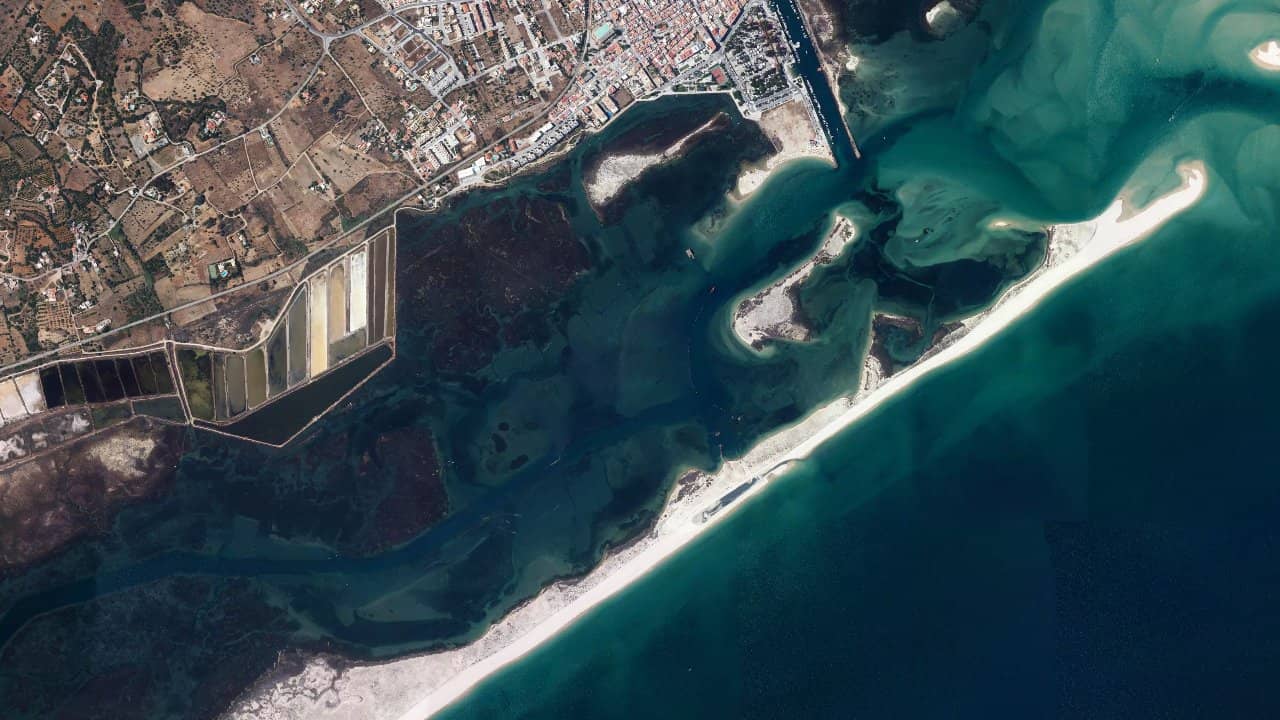
The Fuseta lagoon, in the heart of the Ria Formosa natural park, is located about thirty minutes from Faro. You navigate between sandbanks, shallow water, and islets, with the village of Fuseta and the salt marshes in the background.
This spot is appreciated for its ultra flat water and shallow bottom, ideal for practicing maneuvers with confidence. You can ride on the lagoon side for freestyle and big air, then cross the sandbank to find chop and small waves on the ocean side.
Les données de vent affichées ici proviennent d’ERA5 (via Open-Meteo) sur 4 ans, retraitées pour refléter des conditions réalistes.
👉 Le vent moyen a été calibré pour éviter la sous-estimation habituelle des modèles.
👉 Les rafales ont été corrigées par un ratio médian afin d’éviter des valeurs extrêmes irréalistes.
👉 Chaque jour est résumé par le vent médian (P50) observé pendant les heures utiles (8h–20h), puis classé dans des plages de vent.
👉 Le mode pondéré mélange vent moyen et rafales pour refléter au mieux le vent ressenti.
The water entry is from the sand strip inside the Ria Formosa, facing the village of Fuseta. The launch area is rather small, so it is important to organize well among riders to rig and launch safely. The prevailing wind comes from the SW to W, which generally gives a side-shore to side-on wind relative to the lagoon beach. This orientation makes navigation comfortable, with a natural return to the shore.
In the lagoon, the water surface is very flat at high tide, perfect for freestyle, engaged transitions, and long runs at full speed. At low tide, large areas become very shallow, sometimes with exposed sandbanks: this is ideal for accompanied beginners, but less suitable for foiling. When the wind picks up, a slight chop forms in the middle of the lagoon, never becoming really uncomfortable.
The spot works at all tides, but navigation is most pleasant around mid-tide and high tide, when there is enough depth to take long runs without worrying about sandbanks. Several local schools sometimes mark a teaching area, with riders concentrated in a specific sector. When navigating independently, you move away from these areas to enjoy a vast space more open to the wind or downwind of the school.
By crossing the sandbank towards the Atlantic, you access a second playground on the ocean side. There, the wind generally remains side-shore with a chop/chop water surface punctuated by small waves, interesting for sending some jumps or working on surfing in accessible conditions. However, you need to manage the shorebreak on days with more pronounced swell. Navigation takes place within the natural park, with fishing boats and shuttles to the islands: it is important to keep a good safety distance from the channel and vessels.
The ideal conditions in Fuseta are around a wind of 15 to 25 knots from the W to SW, which means a side-shore to side-on wind in the lagoon. With these strengths, the water surface remains ultra flat and the lagoon is sufficiently filled to navigate with complete peace of mind. In summer, the afternoons of established thermal often provide this perfect window, with navigation in a shorty or lycra.
In the lagoon, the water surface is mostly flat to very flat, especially at high tide and with an established wind. It is a true playground for freestyle, big air, and learning waterstarts or transitions. When the wind picks up, a slight short chop appears in the middle, but the water remains generally smooth compared to an open sea spot.
On the ocean side, the water surface becomes chop/chop with small waves, more or less organized depending on the day's swell. On days with low swell, there is regular chop and some ramps for jumping. When the swell strengthens, the sandbank can generate small to medium playful waves, interesting for trying strapless or varying sessions. The sand and the absence of immediate rocks in the main area provide a rather healthy environment for practice, as long as you stay away from the channel.
In the lagoon, the current is moderate and linked to the ebb and flow of the tides. It is mainly felt near the passes and the channel used by boats, where it can be more pronounced, especially at mid-tide rising or falling. In the main navigation area, the current is generally manageable for all levels, but it is felt more in narrow areas or close to the exit to the ocean.
On the ocean side, the current is more noticeable, especially on days with swell or when the tide pushes strongly along the beach. There can then be a slight drift current along the shore and water returns near the sandbanks. It is important to take into account the tide times and coefficients to avoid drifting towards the passes or out to sea.
For an average size around 75–80 kg, you most often navigate between 8 m² and 11 m² during the thermal season. On days of moderate thermal, a 10–11 m² will be comfortable, and when the wind picks up well in the late afternoon, a 7–9 m² becomes ideal. Lighter riders may sometimes go down to 6–7 m² in good conditions, while heavier riders will keep a 12 m² at the beginning of the wind range.
The main wind regime in season is the Nortada, a thermal that sets in from mid-March to the end of October. In Fuseta, it often comes in from the SW to W, with a clean side-shore wind for kiting. This thermal usually starts in the early afternoon, around 1 PM, and gradually increases to reach its maximum in the late afternoon, with many sessions between 16 and 25 knots.
Sometimes, we encounter episodes of east wind (Levante), mostly in the morning, which can blow strongly at sunrise and then drop in the middle of the day. Outside of summer, more disturbed flows (West, Southwest, sometimes Northwest) also bring nice windy days, but less regularly. Overall, the spot offers an interesting wind rate from spring to autumn, with a real frequency of navigable sessions in summer.
The climate in Fuseta is typically mediterranean/atlantic mild, with hot, dry summers and very moderate winters. In summer, air temperatures often hover around 27–32 °C during the day, with pleasant evenings. In winter, the minimums generally remain above 8–10 °C and days can easily reach 15–18 °C in the sun.
The Faro region benefits from a high level of sunshine for much of the year, which enhances the thermal effect in season. Rain is rare from June to September, more frequent from November to March, but disturbances are often short-lived. Overall, you can kitesurf year-round, with real comfort from spring to autumn.
The Fuseta lagoon is mostly shallow, with a depth ranging from knee to waist in large areas. The depth is quite gradual, which reassures beginners and makes it easier to retrieve the board. The bottom is mainly sandy, sometimes mixed with small areas of mud or shells, but without large rocky blocks in the classic navigation area.
At low tide, some parts become very shallow, to the point of walking on wide sandbanks. At high tide, you generally keep your footing over a good portion of the lagoon, while having enough depth to navigate without the risk of touching the bottom in normal navigation. On the ocean side, the depth increases more quickly, with always a sandy bottom.
In summer, the water temperature in the lagoon hovers around 20–23 °C, sometimes a bit warmer than the ocean due to the shallow depth. A simple lycra or a light shorty is often sufficient from June to September. In spring and autumn, the water is generally between 17 and 20 °C, making the use of a 3/2 mm or 4/3 mm wetsuit comfortable depending on sensitivity.
In winter, the temperature can drop to around 14–16 °C, which requires a slightly thicker wetsuit, like a 4/3 mm or 5/4 mm for the more sensitive. The lagoon remains more pleasant than the neighboring ocean, with less of a cold sensation related to the swell.