Portugal
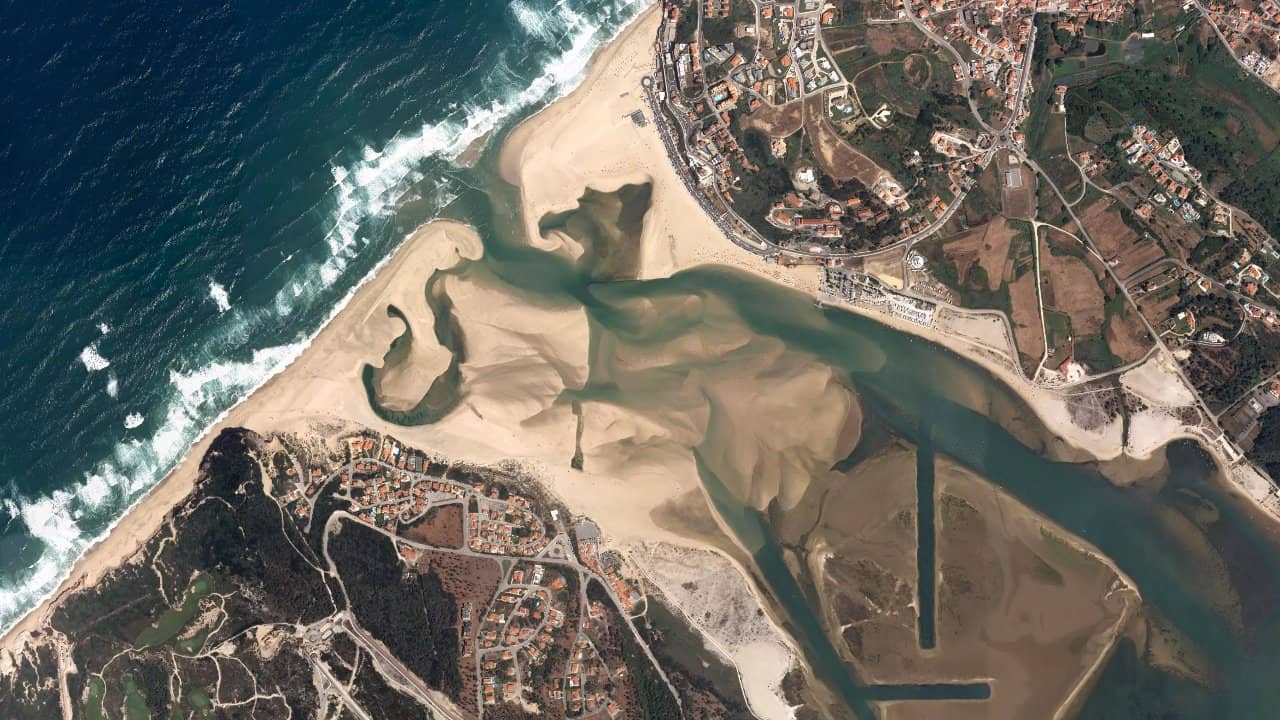
Lagoa de Óbidos, at the mouth of Foz do Arelho, is a versatile spot between lagoon and ocean on the Portuguese west coast. The bocca forms a vast protected water area with views of the dunes and the Atlantic in the background.
It is a spot appreciated for its regular thermal wind and shallow water areas. You can ride either in the lagoon for flat and freeride or by crossing the dune to catch the waves on the ocean side.
Les données de vent affichées ici proviennent d’ERA5 (via Open-Meteo) sur 4 ans, retraitées pour refléter des conditions réalistes.
👉 Le vent moyen a été calibré pour éviter la sous-estimation habituelle des modèles.
👉 Les rafales ont été corrigées par un ratio médian afin d’éviter des valeurs extrêmes irréalistes.
👉 Chaque jour est résumé par le vent médian (P50) observé pendant les heures utiles (8h–20h), puis classé dans des plages de vent.
👉 Le mode pondéré mélange vent moyen et rafales pour refléter au mieux le vent ressenti.
At the bocca of Lagoa de Óbidos, you kite between the exit of the lagoon and the beach of Foz do Arelho. The dominant summer wind is a nortada from the N–NW, which arrives side-on to side-shore on the lagoon mouth area, and rather side-shore on the ocean edge. When it turns more to the west, it becomes more side-on on the beach.
In the lagoon, the water is mostly flat to slightly choppy depending on the wind strength and tide level. At low tide, large areas remain shallow, ideal for freeride and freestyle. At high tide and during filling/draining phases, the current strengthens near the channel and generates chop, especially in line with the exit.
Launching on the lagoon side is done from the sandy beaches near Foz do Arelho or Bom Sucesso, with clear areas for rigging and launching. There is a large launch area on the Bom Sucesso side, more comfortable and wide, while some accesses closer to the bocca are a bit narrower and require careful orientation during launch. You must also respect the seasonal regulations: the area near the estuary on the swimming side is often prohibited for kitesurfing in mid-summer, with a wider opening from September to June for kiting near the mouth.
By crossing the dune, you quickly access the ocean edge. There, the water switches to waves/chop mode with Atlantic waves of varying size depending on the swell. It’s a good option to alternate between flat lagoon and waves in the same session. The beach on the ocean side is wide with a sandy bottom, but launching is more technical when the swell is strong or in case of marked shorebreak.
Kiting takes place over a large area between the inside of the lagoon and the exit towards the ocean. Beginners tend to stay away from the channel, where the water is calm and shallow. More comfortable riders can head towards the bocca or go out on the ocean side to play with the waves. The thermal wind tends to strengthen in the axis of the venturi formed by the hills of Foz do Arelho, often giving a few more knots than the raw forecasts.
In summary, the bocca is very interesting for those who want to enjoy a mix of flat/waves in a very small radius. However, it is essential to consider the tides, prohibited areas in summer, and the current in the channel to choose where to kite and where to safely land your kite.
The ideal conditions at the bocca of Lagoa de Óbidos occur with a well-established wind from the N to NW sector, between 15 and 25 knots. In this configuration, you enjoy a comfortable side-on to side-shore wind on the lagoon side, with a good flat water area for freestyle, and a more powerful side-shore wind on the ocean side to catch the waves. An intermediate tide at mid-height limits the strength of the current while keeping enough depth for comfortable navigation.
Inside the lagoon, the water is mostly flat to very slightly choppy, perfect for freeride, freestyle, and learning. The shallow depth over large areas makes falls quite forgiving, with a mostly sandy bottom.
Near the bocca, the water becomes more agitated due to the combined effect of the current and wind, especially at rising or falling tide. On the ocean side, the spot switches to wave mode with Atlantic waves that can remain moderate or become more powerful depending on the swell. There is chop between sets and sometimes a marked shorebreak, which requires a bit more skill for launching and returning to the beach.
In the lagoon, the current is highly dependent on the tide. In the middle of the lagoon, it generally remains moderate, but it increases significantly near the mouth channel, especially during the draining phase towards the ocean. This current can quickly shift a rider who remains static or falls often.
On the ocean side, there is a drift current along the beach, influenced by the combination of swell/wind, generally in line with the coast. It can be noticeable on days of strong swell. Overall, it requires keeping an eye on the buoys, the drift, and other users, especially during active rising or falling tides.
For an average build around 75–80 kg, the most commonly used kite sizes generally range between 8 m² and 11 m² in summer on the lagoon. On lighter days or in spring/autumn, a 12 m² can be useful, while the ocean side with more wind sometimes allows for 7–8 m². Lighter builds will often go down to 7–9 m², and heavier builds will go up to 10–12 m².
Lagoa de Óbidos mainly operates on a thermal wind regime of nortada in summer. As soon as the sky is clear and temperatures rise, the wind from the N to NW sector accelerates in the early afternoon and can reach 15 to 25 knots in the lagoon, often more on the ocean side. This wind is not always fully reflected in the statistics, which often underestimate the number of rideable days.
In spring and autumn, the spot works with both remnants of thermals and Atlantic depressions, which can bring more irregular winds, sometimes stronger and more oriented W or SW. In winter, the winds are more related to depression systems, with very windy days alternating with calm periods.
The climate in Foz do Arelho is of the mild Atlantic type. Summers are generally dry, sunny, and windy, with air temperatures often ranging between 22 and 28 °C during the day. Nights remain pleasant, rarely cold by the lagoon.
In spring and autumn, temperatures generally hover around 15 to 22 °C, with a bit more humidity and some Atlantic depressions that can bring strong winds and rain. Winter is cooler and wetter, with highs around 12 to 17 °C, but it is still possible to kite for those who are well equipped.
In the lagoon, the depth is gradual and generally shallow over large areas, with a mostly sandy bottom. You can often stand for several tens, even hundreds of meters depending on the tide, which is reassuring for learning and maneuvers. Near the channel and the bocca, the depth increases more quickly and the current strengthens, requiring more vigilance.
In summer, the water temperature in the lagoon often hovers around 19 to 22 °C, sometimes a bit warmer than the neighboring Atlantic, allowing for kiting in a shorty or light wetsuit. In spring and autumn, the water typically drops to 16 to 19 °C, making a 3/2 mm or 4/3 mm wetsuit comfortable. In winter, the temperature can drop to around 14–15 °C or slightly less on the ocean side, which justifies a thicker wetsuit with possibly booties for longer sessions.