Portugal
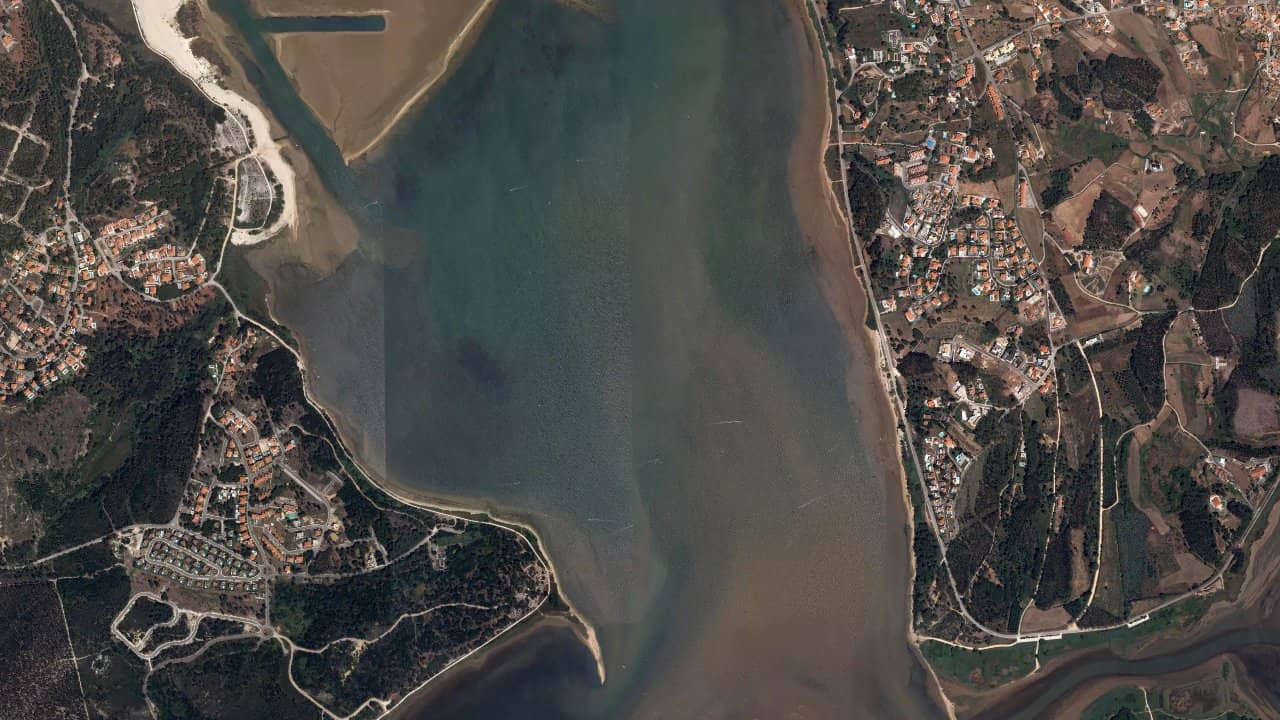
The lagoon of Lagoa de Óbidos, at Foz do Arelho, stretches between the Atlantic Ocean and wide sandbanks. You navigate with the white houses of Foz on one side and the hills covered with pines and eucalyptus on the other, in a very calm atmosphere outside of summer.
It is a spot appreciated for its shallow waters and consistent wind, fueled by the Nortada in the afternoon. Between the inner area near Bom Sucesso and the mouth on the ocean side, riders find both flat water to progress and accessible waves to vary their sessions.
Les données de vent affichées ici proviennent d’ERA5 (via Open-Meteo) sur 4 ans, retraitées pour refléter des conditions réalistes.
👉 Le vent moyen a été calibré pour éviter la sous-estimation habituelle des modèles.
👉 Les rafales ont été corrigées par un ratio médian afin d’éviter des valeurs extrêmes irréalistes.
👉 Chaque jour est résumé par le vent médian (P50) observé pendant les heures utiles (8h–20h), puis classé dans des plages de vent.
👉 Le mode pondéré mélange vent moyen et rafales pour refléter au mieux le vent ressenti.
The lagoon offers several well-defined navigation areas. The inner part, towards Bom Sucesso and the kite schools, offers a large shallow water area with a mostly sandy bottom. Here, one navigates on a water surface that is rather flat to slightly choppy, ideal for freeride, freestyle, and beginner lessons. The launch is done from small beaches or sandy ramps, with enough space to rig and take off safely, even if the take-off area is more limited than at the ocean's edge.
The dominant wind in season is the Nortada, a flow from north to northwest that generally enters side-on relative to the main shores of the lagoon. On certain stretches of shore, it can become more side-shore or slightly onshore, which remains comfortable for safety. On the ocean side, at Foz do Arelho, the wind most often arrives cross-onshore with chop and medium-sized waves depending on the swell. Riders can move from the lagoon to the waves by simply crossing the dune.
The spot works at all tides, but the tide significantly modifies the depth and behavior of the water surface. At low tide, some areas become very shallow and emerge, creating pockets of super flat but reducing the navigable area. At high tide, the water surface widens but the chop and current increase, especially near the mouth. Local rules must also be respected: the area near the estuary, on the Bom Sucesso side, is prohibited for kiting in mid-summer in certain sections (swimming, bathing area) while the inner lagoon remains open all year round.
The best areas for beginners are found in the inner lagoon, where one can stand for long distances and where the wind is slightly reinforced by a venturi effect between the hills of Foz do Arelho. Intermediates and advanced riders enjoy the large shallow areas to work on maneuvers, jumps, and freestyle, or cross the dune to seek the waves of the Atlantic. Launching is generally easy, but one must remain attentive to the tide, sandbanks, current areas near the channel, and swimming markings in summer.
The ideal conditions for the lagoon are with a wind from the N to NW sector, blowing between 15 and 25 knots. In this range, one enjoys an excellent compromise between power, control, and water quality. For beginners, a steady wind around 15–20 knots in thermal conditions allows for safe learning in shallow water. More experienced riders will appreciate days with 20–30 knots for committed freestyle or wave sessions on the ocean side.
Inside the lagoon, the water surface is mainly flat to slightly choppy, with large areas of smooth water as soon as the wind settles and the tide is right. At higher tide or when the wind picks up, a small chop forms, but it remains largely manageable for freeride and freestyle. The sandbanks and shallow depth create very smooth surfaces in places, perfect for technical maneuvers and progression.
On the ocean side, at Foz do Arelho, the sea state depends on the Atlantic swell. Generally, there are small to medium-sized waves, more accessible than on the more exposed spots of Peniche, but sufficient for surfkiting and jumps. The cross-onshore wind can make the water surface a bit choppy near the shore, with cleaner waves on well-formed sandbanks. This lagoon/waves duality allows choosing one's playground according to the level and desire of the day.
Inside the lagoon, the current remains moderate most of the time, but it varies with the tide. At high and low tide, water circulates between the different basins and the mouth, creating a more noticeable current near the channel and the deeper areas. However, it remains manageable for the majority of riders, especially in the shallow areas used for learning.
Near the mouth and on the ocean side, the tidal current can be significantly stronger, especially during high coefficients or in the presence of swell. Riders must remain vigilant to the pull towards the channel and the lateral shift caused by the combined wind-current drift. It is recommended to navigate while staying in the main area of the lagoon or on the safest sandbanks if one is not yet familiar with the spot.
In summer, with the thermal Nortada, most riders use kites around 8–11 m, which covers the majority of conditions on the lagoon. Lighter riders may go down to 7–8 m on very windy days, while heavier riders will typically go up to 10–12 m when the wind is more established but moderate. In the interseason or with more irregular wind, it is not uncommon to see kites of 12–14 m to take advantage of lighter days.
The wind regime is dominated by the Nortada, a wind from the N to NW sector that sets in on sunny days, mainly from May to September. This thermal wind strengthens during the day, often starting from late morning to reach its peak in the afternoon. On the coast and at Foz do Arelho, the Nortada frequently blows between 20 and 30 knots, or even a bit more on the windiest days.
Inside the lagoon, this wind is generally a bit less strong, around 12 to 25 knots depending on the situation, but it benefits from a local venturi effect that can strengthen it in certain narrow areas. Outside the thermal season, the spot works with Atlantic disturbances, bringing more irregular winds, sometimes strong and from various directions, with more rain in winter. Overall, the summer period remains the most reliable with a very good rate of navigable days.
The climate at Lagoa de Óbidos is of a mild Atlantic type, with summers tempered by the ocean and relatively humid winters. In summer, air temperatures often hover around 22–28 °C during the day, with cooler nights. In winter, maximum temperatures are usually between 12 and 17 °C, with more depression systems and rain.
Spring and autumn still offer pleasant conditions with intermediate temperatures and frequent wind, although the thermal Nortada is less pronounced than in mid-summer. The presence of the ocean and the lagoon limits large thermal amplitudes, but the reinforced wind can give a feeling of coolness, especially in the late afternoon. A wetsuit is therefore useful for a good part of the year.
The lagoon is generally shallow, with wide areas where one can stand for several tens or even hundreds of meters, which is ideal for learning and freestyle. However, the depth varies greatly with the tide: at low tide, some sandbanks emerge and reduce the navigable area, while at high tide, the channels become more deep and the currents more noticeable. The bottom is mostly sandy, sometimes mixed with muddier areas or small pebbles depending on the spots, but remains generally pleasant and forgiving in case of falls.
The water temperature in the lagoon follows that of the Atlantic, with sometimes a slight warming in the shallow areas. In the height of summer, the water hovers around 19–21 °C, allowing for navigation in a 3/2 mm wetsuit or even a shorty for the less chilly. In spring and autumn, the water is generally between 16 and 19 °C, making a 4/3 mm wetsuit comfortable.
In winter, the water temperature can drop to 14–16 °C, and a 4/3 to 5/4 mm wetsuit with possibly gloves and booties becomes recommended for long sessions. The lagoon, remaining shallow, can gain one or two degrees compared to the ocean on sunny days without strong wind.