Netherlands
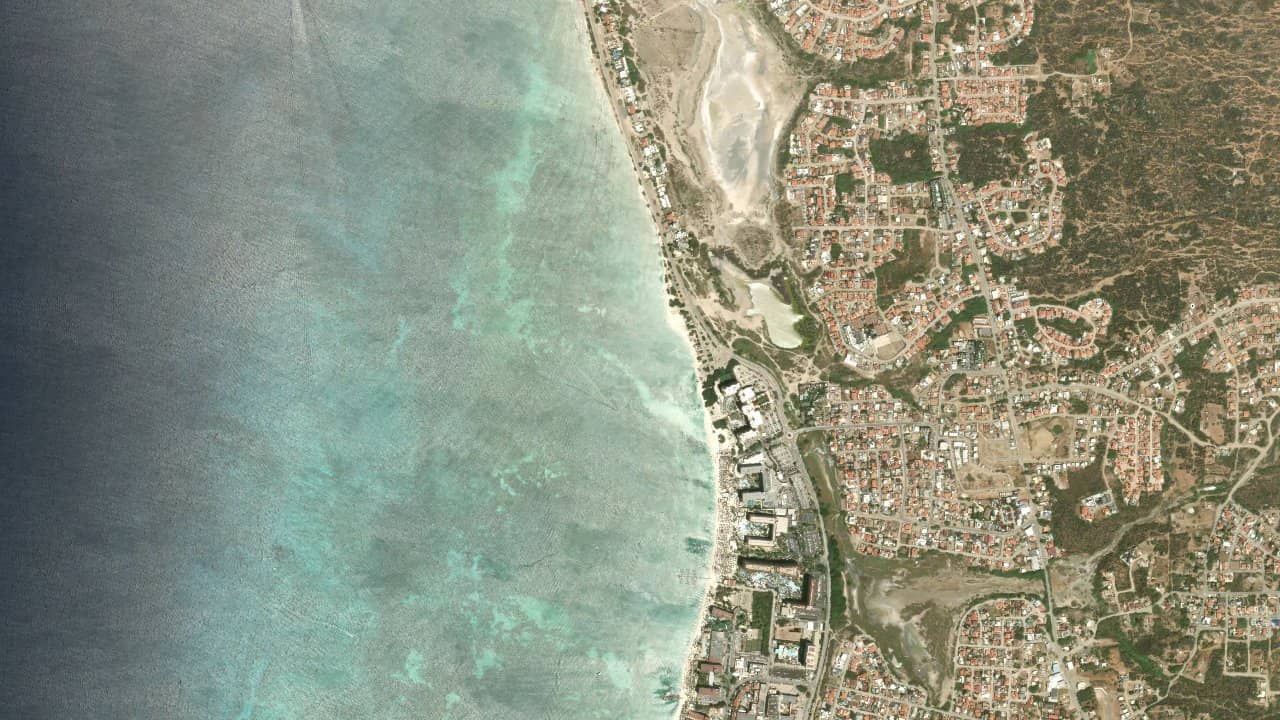
Fisherman's Huts, in Noord, Aruba, is one of the most well-known spots on the island for kitesurfing and windsurfing. The area is appreciated for its easy access, very sporty atmosphere, and the large number of schools and rescue boats nearby.
The spot works best when the wind is well established. The water is generally accessible, with a close-to-shore area convenient for launching and progressing, and a bit more relief offshore for riders who want to push harder. It is a very busy spot, but also very structured for practice.
The wind data shown here comes from ERA5 (via Open-Meteo) over 4 years, reprocessed to reflect realistic conditions.
👉 Average wind has been calibrated to avoid the usual underestimation of models.
👉 Gusts have been corrected by a median ratio to avoid unrealistic extreme values.
👉 Each day is summarized by the median wind (P50) observed during useful hours (8am–8pm), then classified into wind ranges.
👉 The weighted mode mixes average wind and gusts to best reflect felt wind.
At Fisherman's Huts, the wind most often arrives with a side-off to offshore component according to sources, although some local centers sometimes describe a light side-onshore on certain days. In practice, the spot should be considered as an exposed spot, where one navigates with caution and where rescue is part of normal usage. The conditions are good for clean navigation, but the return to the shore can become complicated if the wind weakens.
The water is generally flat to slightly choppy near the shore, then can become more irregular further out. The tide has little effect on the overall quality of the spot, as the area remains very shallow over a large part of the bay. You can stand for a good distance, which facilitates launching, entering the water, and the first runs, but you must remain attentive to other riders and swimmers in the launch area.
The launch takes place on a fairly narrow beach with a dedicated area for kites and schools. The takeoff must remain clean and organized, as the spot is very busy and lines can quickly cross. Navigation mainly occurs in a wide corridor, with enough space to make runs, work on jumps, and go upwind. In case of stronger winds, the spot becomes more technical for beginners due to the drift offshore.

The spot performs best with a wind well established between 18 and 28 knots, ideally steady and not too unstable at the shore. The most favorable directions for the session, according to field reports, are mainly W, SW, NW, and S, but this should be verified on-site as the actual wind configuration is often dominated by the east trade winds in Aruba.
To enjoy the spot safely, it is better to aim for a day when the wind is strong enough to ensure a return to the shore and where the launch area remains clear.
The water is most often flat in the area close to the shore, with a small chop that may appear further out. When the wind picks up, you can find a bit more texture on the water, but the spot is primarily oriented towards flat water and progression.
The shallow depth greatly helps with launching and the first relaunches. It is a pleasant spot for working on edges, transitions, and jumps, provided you stay attentive to the density of riders in the area.
Currents are generally weak to moderate, but they can be felt more strongly depending on the wind intensity and the navigation area. The tide has a limited impact on the spot, as the area remains very shallow and not sensitive to changes in water level.
However, one must remain vigilant if going far offshore, as an offshore or side-off wind can complicate the return. The key point here is not so much the tide but the management of drift and distance from the shore.
At Fisherman's Huts, the most useful sizes are generally between 7 and 12 m², with a quiver core around 8, 9, and 10 m² for many sizes. When the wind picks up well, a 7 or 8 m² can become the right option.
Heavier riders can keep a 11 or 12 m² for lighter sessions, but the spot is especially suited for intermediate kites as soon as the trade wind is in place.
The local wind is that of the trade winds, generally oriented east to northeast in Aruba. It is often a steady and strong wind, with days of 20 to 27 knots quite frequent at Fisherman's Huts. Local sources also report that the wind can be offshore and sometimes a bit gusty near the shore.
At this spot, you need to assess the day before heading out. When the trade wind is well in place, the spot works very well, but if the wind drops, the offshore component quickly becomes a factor not to underestimate. The best sessions occur with a well-established wind and a fairly clean direction.
Aruba enjoys a warm and dry climate year-round, with air temperatures often between 25 and 30°C. The water is also very pleasant, around 26 to 28°C most of the time, allowing for sailing in a lycra or very light wetsuit.
The most comfortable months for kitesurfing are generally those when the trade winds are well established, with a season that remains active almost all year. The most stable period often occurs between December and August, but the spot remains navigable for many months due to the consistency of the wind in Aruba.
The depth is very shallow near the shore, with a generally sandy bottom and some areas where you can find rocks or pebbles. You can stand for a good distance, which facilitates launching and reassures beginners.
The further you go out, the deeper it gradually becomes, but the spot is known for its very accessible area close to the shore. Just keep in mind that the bottom is not uniform everywhere and that some parts can be more technical to walk on.
The water remains warm year-round, with values generally around 26 to 28°C. Therefore, there is no need for a thick wetsuit, and a light shorty or even a simple lycra is often sufficient.
Seasonal variations are low, making the spot very comfortable for long sessions without thermal constraints.