Italy
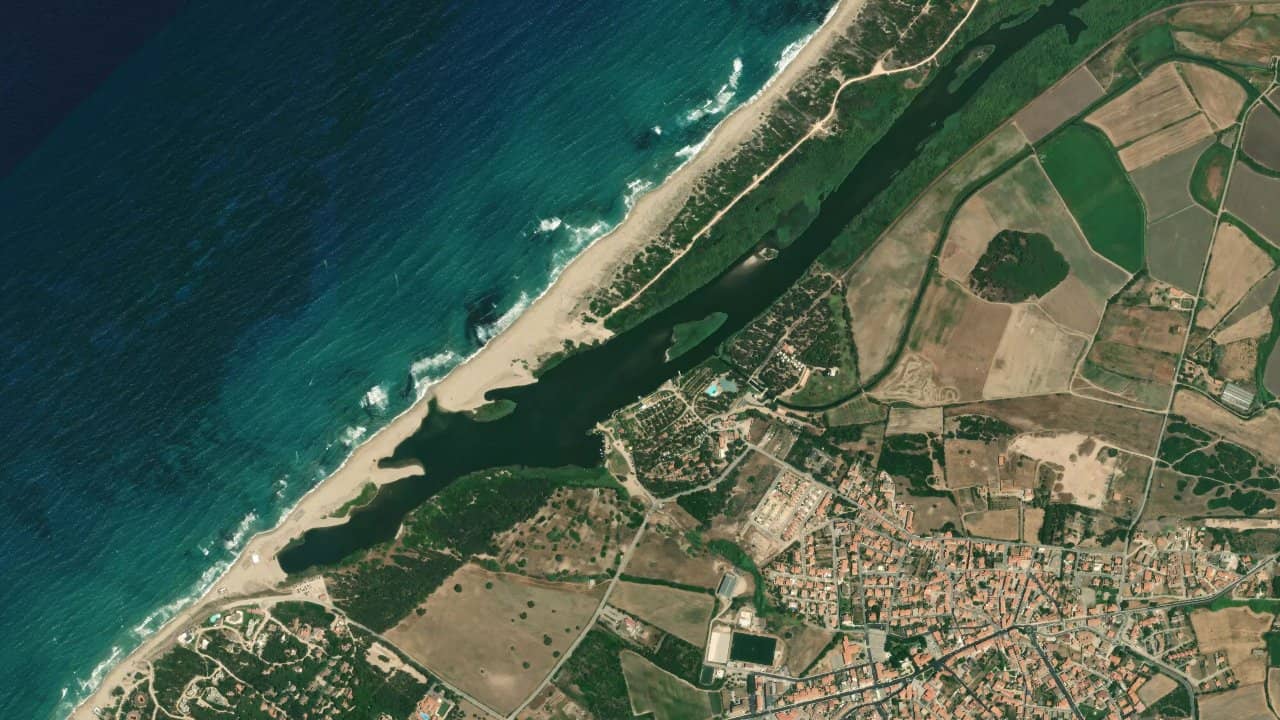
The Coghinas lagoon, at the foot of the La Foce campsite in Valledoria, is located at the mouth of the river that flows into the Gulf of Asinara. Between the sandy strip and the flat water of the river, the scenery is simple and wild, with the long beach of San Pietro a Mare in the background.
It is a spot appreciated for its shallow water and consistent wind, where several kite schools share the lagoon. You can ride either in the ultra flat lagoon or by crossing the sandbar to catch the waves offshore in the open sea.
Les données de vent affichées ici proviennent d’ERA5 (via Open-Meteo) sur 4 ans, retraitées pour refléter des conditions réalistes.
👉 Le vent moyen a été calibré pour éviter la sous-estimation habituelle des modèles.
👉 Les rafales ont été corrigées par un ratio médian afin d’éviter des valeurs extrêmes irréalistes.
👉 Chaque jour est résumé par le vent médian (P50) observé pendant les heures utiles (8h–20h), puis classé dans des plages de vent.
👉 Le mode pondéré mélange vent moyen et rafales pour refléter au mieux le vent ressenti.
The spot is located right at the mouth of the Coghinas river, with an inner lagoon separated from the sea by a sandbar. The main launch area is from the zones used by the schools, directly at the edge of the lagoon, with enough space to rig and launch on the sand. The beach on the sea side is wide, but in peak season it can be crowded with bathers, which pushes most riders to stay in the lagoon or to follow the coast a bit to get away.
The main wind is the NW sector Mistral, which generally arrives side-on relative to the sandbar on the sea side and side to side-on in the lagoon depending on where you enter the water. The Grecale (NE) also works well and comes in rather side in the lagoon. These orientations provide a safe body of water, with a natural return to the beach in case of problems. On summer thermal days, the breeze often strengthens in the afternoon, ensuring consistent sessions.
In the lagoon, the water is mostly flat with some slight chop when the wind rises above 20 knots. The depth is often shallow over a good part of the area, making body-dragging, waterstarting, and freestyle easier. It is an ideal playground for lessons and for working on maneuvers with confidence. Further offshore from the lagoon, when crossing the sandbar to go to sea, you find a more formed body of water, with chop and waves that grow when the Mistral strengthens.
There is almost no marked tidal influence, with the lagoon's level remaining quite stable throughout the day. However, the river's flow can slightly modify the shallowest areas, especially after heavy rain episodes. Local schools usually mark the navigation sectors and areas reserved for teaching, allowing for good coexistence between beginners and independent riders.
The launch area is sandy, with no major obstacles, but you need to keep an eye on other kites and on foil fins on the ground during peak season. Access to open water on the sea side is done by crossing the sandbar on foot, allowing you to choose between a freestyle run in flat water in the lagoon or a more challenging run in the chop and waves of the Mediterranean.
The ideal conditions for riding in the lagoon are a wind from NW or NE established between 15 and 25 knots, providing a flat to slightly choppy water perfect for freestyle and speed runs. To catch the waves on the sea side, a strong Mistral around 20 to 30 knots offers the best conditions.
In the Coghinas lagoon, the water is mostly flat, with very smooth areas ideal for freestyle and learning. When the wind picks up, a bit of chop appears in the middle of the lagoon, but it remains largely manageable, even for progressing riders. The edges are often calmer and allow for easy landing or relaunching of the kite.
By crossing the sandbar to go out to sea, you encounter a more agitated body of water, with chop and waves that grow with the Mistral and gusts. On well-established days, you can find nice ramps for jumping or working on strapless surfing. The transition between the flat water of the lagoon and the formed sea occurs over a very short distance, allowing for easy alternation of riding styles.
In the lagoon, the current is weak and does not hinder navigation most of the time. However, it can be a bit more noticeable near the mouth when the river flows into the sea, especially after heavy rains. On the sea side, a light coastal current can set in with strong winds and swell, but it generally remains moderate.
As there is little tidal influence, the water level changes little throughout the day, and the markers remain stable. You just need to stay vigilant near the river's exit area, where the fresh water / seawater mix can create some more pronounced water movements.
For an average-sized rider around 75–80 kg, the most commonly used kite sizes are around 8 to 11 m² for the majority of sessions in Mistral or Grecale. On stronger days, a 7 m² kite can become enjoyable, while in lighter thermal winds at the beginning or end of the season, you can go up to 12 m² or more.
The spot is primarily fed by the Mistral (NW), a frequent wind in Sardinia that can blow between 15 and 30 knots depending on the situation. This wind is often reinforced by local effects, especially in summer, resulting in well-established days around 15 to 25 knots. The Grecale (NE) is the second frequent orientation, with similar strengths and a suitable angle for the lagoon.
During the summer, a thermal regularly sets in in the afternoon, coming from the sea and adding to the synoptic flow, which stabilizes the wind and makes it very consistent. Outside of summer, all directions can come in with disturbances, but the spot remains especially interesting when the northern quadrant is active.
Valledoria enjoys a Mediterranean climate with hot, dry summers and mild winters. From June to September, air temperatures hover around 25 to 30 °C during the day, with pleasant evenings. Spring and autumn offer cooler conditions but are still very manageable, with temperatures often between 18 and 24 °C.
Winter remains relatively mild for the latitude, but the perceived temperature can be cooler with the wind, necessitating a suitable wetsuit. The period from April to October is the most comfortable for chaining sessions while enjoying the beaches and the services of the campsite.
In the lagoon, the depth is gradual with wide areas where you can stand, very practical for teaching and first attempts at waterstart. The bottom is mostly sandy, with some areas being more muddy or grassy related to the river. On the sea side, the depth increases gradually, with a sandy bottom pleasant underfoot in the first meters.
In summer, the water temperature easily rises to around 23 to 25 °C, allowing for riding in a shorty or even in lycra for the less chilly in the shallow lagoon. In spring and autumn, the water typically drops to 18 to 21 °C, making a 3/2 mm or 4/3 mm wetsuit comfortable.
In winter, the temperature can drop below 16 °C, and a thicker wetsuit with possibly booties becomes recommended, especially if spending time in the water learning or working on tricks.