Italie
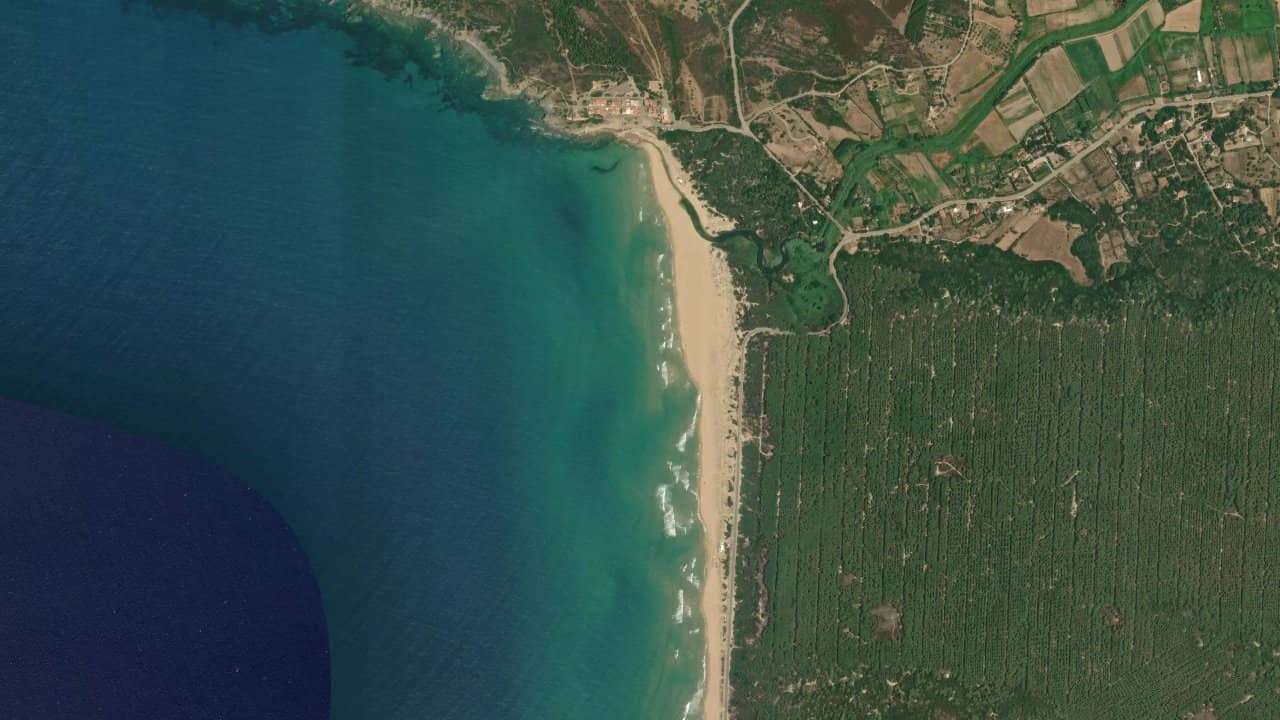
Spiaggia I Pini (Compingius), in Buggerru, is a spot in the southwestern part of Sardinia appreciated for its large space and relatively easy access. The beach is quite suitable for kiting when the wind is good, with a natural and minimally urbanized atmosphere.
People come here mainly to ride in good wind conditions and enjoy a water surface that is often usable. The spot remains interesting for riders looking for a wild setting, with space to set up equipment and get in the water without too many constraints.
The wind data shown here comes from ERA5 (via Open-Meteo) over 4 years, reprocessed to reflect realistic conditions.
👉 Average wind has been calibrated to avoid the usual underestimation of models.
👉 Gusts have been corrected by a median ratio to avoid unrealistic extreme values.
👉 Each day is summarized by the median wind (P50) observed during useful hours (8am–8pm), then classified into wind ranges.
👉 The weighted mode mixes average wind and gusts to best reflect felt wind.
Spiaggia I Pini mainly works with winds from the W to NW sector, which generally arrive cross-shore to slightly onshore depending on the exact axis of the beach. According to available information about the Buggerru area, the spot handles the maestrale well and can also remain playable with nearby orientations when the flow is well established. The water surface is generally cleaner with a little-formed sea, but it can become more irregular if the swell comes in or if the wind strengthens.
The launch is from a large sandy beach, with space to rig and take off, which is a real positive point for this area. While sailing, one must remain attentive to the local bay configuration and the possible presence of more exposed areas near the ends. The spot is generally more comfortable at low tide or mid-tide when the beach is well cleared, but it remains usable without major tide constraints like on some bank or channel spots.
In summary, it is a spot rather oriented towards steady wind and simple navigation, with a reasonable safety margin for preparation at the shore. When the wind is well established, one can have great sessions without too much logistical pressure, but it is necessary to keep a close watch on the sea if the swell from the open sea starts to come in.

The best sessions come with wind from SW to NW, well-established and clean, around 18 to 28 knots. In this wind strength range, the spot becomes particularly interesting for regular navigation and maintaining good control of the kite.
When the wind is too weak, the spot quickly loses its appeal. Conversely, strong and irregular wind can make returning to shore more technical, especially if the sea starts to form.
The water surface is most often flat to slightly choppy when the wind is clean and the swell remains low. In this case, the session is comfortable, and the beach allows for easy navigation at the start.
If the swell comes in, the spot can take on a bit more texture with sets of waves or more pronounced chop. It remains more of a formed water surface than truly wave conditions, but sufficient to vary the stance and work on jumps.
Currents are generally moderate, but they can strengthen if the sea is choppy or if swells enter the bay. To my knowledge, there is no decisive tide like on some Atlantic spots, but it is still necessary to monitor drift related to the wind and coastal relief.
When the sea is more active, one must be attentive to returning to shore and the downwind drift. However, the spot remains quite readable for a rider accustomed to interpreting coastal effects.
At this spot, the most useful sizes are often 8 to 10 m² for an average build in the usual session wind. In lighter conditions, an 11 m² can be useful, while a 7 m² becomes relevant when the maestrale picks up stronger.
With the forecasted wind, it is necessary to plan for a fairly wide range of equipment, especially if you want to cover multiple navigation scenarios. Heavier riders can naturally go down a size.
The local regime is marked by the maestrale, which often brings wind from the NW on the western Sardinian coast. Depending on the weather situation, winds from the W can also feed the spot, with an intensity often sufficient for kiting in freeride or freerace.
When the flow sets up correctly, one can have well-established and usable wind for several hours. The best windows are often those where the gradient is clean, without too much thermal disturbance or rotation along the coast.
The climate in Buggerru is typically Mediterranean, with hot and dry summers and milder winters. During the peak season, the air is often warm on the coast, which enhances comfort in the water but can also make rigging more tiring on the sand.
The best sailing periods often extend from spring to autumn, when wind episodes are more frequent and the water temperature remains pleasant. In winter, the spot can still work, but with a cooler feel and sessions more dependent on disturbed weather patterns.
The depth increases quite gradually from the shore, with a sandy bottom in the swimming and navigation area close to the shore. This is a reassuring point for getting in the water and the first runs.
The spot is simpler than a rocky or very technical site, but it is still necessary to keep an eye on the exact configuration of the shore depending on the state of the sea. The local crowd mentions an area without complex bottom features, which makes it a rather accessible spot.
The water is often most pleasant from June to September, with temperatures generally around 22 to 26°C. In mid-season, it remains acceptable, often between 18 and 21°C.
In winter, the water becomes cooler, with values close to 14 to 16°C. A thicker wetsuit is then recommended to stay comfortable during long sessions.