Italy
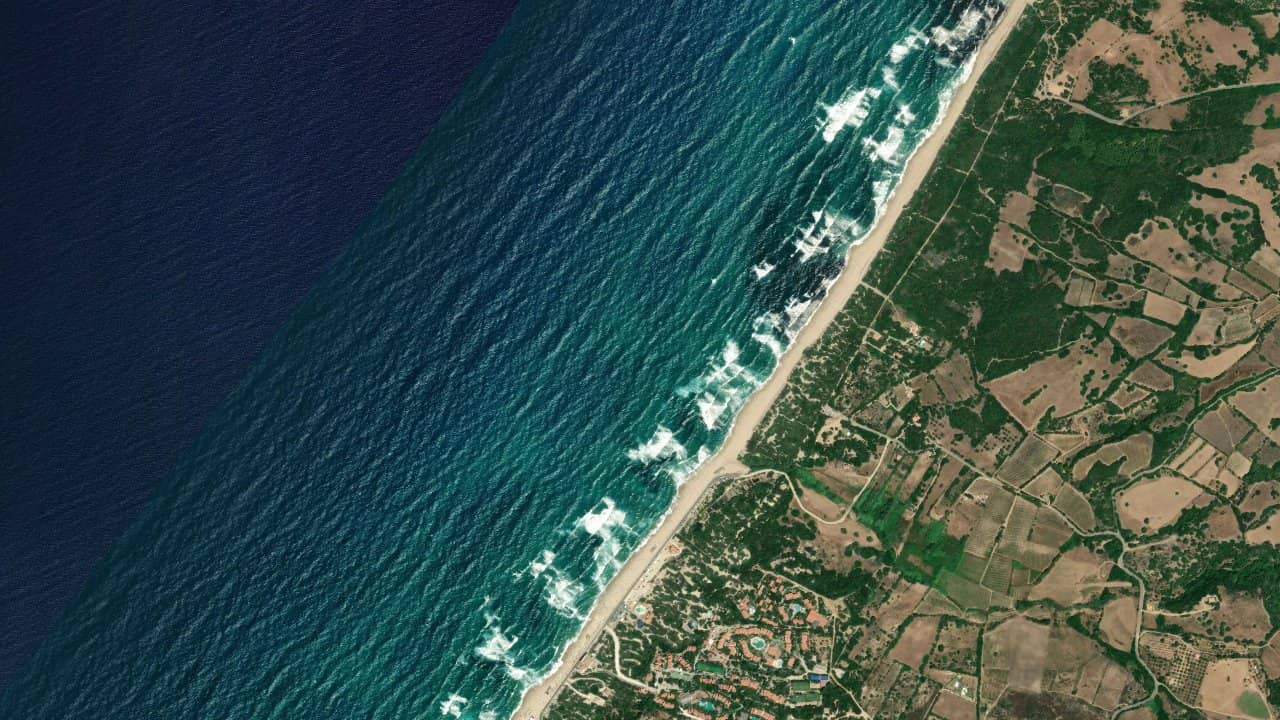
Li Mindi beach, on the northern coast of Sardinia in Badesi, stretches along a wide ribbon of golden sand with large dunes covered in Mediterranean scrub in the background. The atmosphere is quite calm and natural, even in the height of summer, with plenty of space to set up your gear without stepping on each other.
This stretch is part of the large Marina di Badesi beach, well exposed to the wind and frequented by kitesurfing and windsurfing enthusiasts. The water is crystal clear and the bottom does not get deep right away, which is reassuring for launching and the first runs offshore.
Les données de vent affichées ici proviennent d’ERA5 (via Open-Meteo) sur 4 ans, retraitées pour refléter des conditions réalistes.
👉 Le vent moyen a été calibré pour éviter la sous-estimation habituelle des modèles.
👉 Les rafales ont été corrigées par un ratio médian afin d’éviter des valeurs extrêmes irréalistes.
👉 Chaque jour est résumé par le vent médian (P50) observé pendant les heures utiles (8h–20h), puis classé dans des plages de vent.
👉 Le mode pondéré mélange vent moyen et rafales pour refléter au mieux le vent ressenti.
The Li Mindi spot is located on the large bay of Badesi, generally oriented east-west, facing the Gulf of Asinara. The Maestrale (NW) wind is the dominant regime and arrives here side-shore to side-on-shore from the right, providing good safety conditions and a large drift area along the beach. West sector winds (W) also come in well, always with a comfortable orientation for going upwind.
The beach is wide, with plenty of space to rig and launch kites. The sand is fine to medium, without annoying pebbles for walking barefoot. There is a dedicated kite zone on this stretch of coast, connected to the kitesurfing schools in Badesi, which facilitates the organization of launches and landings during the season. It is advisable to stay within this marked area to avoid disturbing bathers in summer and to benefit from potential assistance from the schools.
Launching is done directly into the wind, in an area where the bottom remains shallow for several dozen meters. You can stand for a long time, which is reassuring for progressing riders and practical for helping a beginner manage their kite at the shore. Further offshore, the depth increases gradually and the water surface becomes more formed with the established wind.
In moderate wind, the water surface is often in chop with regular chop, especially in the area of the strongest wind. When the Maestrale strengthens or a west-northwest swell comes in, waves form all along the shore, with cleaner sets on certain sandbanks. In these conditions, the spot becomes very interesting for surfkite, but requires more technique for passing the bar and maneuvers near the shore.
There are no major obstacles directly in front of the beach, but one must remain attentive to the drift along the coast and the potential presence of marked swimming areas in high season. Local schools often organize navigation on a specific stretch of the beach, with an implicit channel for launching in front of the kite zone. In winter and off-season, the beach is much freer, but the sea can be stronger with powerful waves when a depression passes offshore.
The large available space, the generally side wind direction, and the bottom configuration make Li Mindi an accessible spot, especially for those who already have the basics of water start and going upwind. In heavy swell or very strong wind, the spot becomes more challenging and is better suited for intermediate to advanced riders.
Ideal conditions at Li Mindi occur with a Maestrale established between 18 and 25 knots, blowing side to side-on-shore. In this wind range, the water surface offers a good compromise between chop and small waves, with maximum safety due to the wide beach. For surfkite, days of sustained Maestrale accompanied by a NW or W swell are particularly interesting, with regular waves on the sandbanks.
The water surface at Li Mindi varies between chop and wave depending on wind strength and swell presence. With moderate Maestrale wind and no significant swell, there is regular chop, fairly clean, with a playable water surface for freeride and old school freestyle. The stronger the wind, the more pronounced the chop becomes, especially offshore, making the spot more physical.
When a NW or W swell sets in, waves form on the sandbanks, with larger sets offshore and smaller reforms near the shore. This opens up good surfkite sessions, with wave sizes varying according to the depressions, potentially reaching over a meter on good days. The shorebreak can become powerful in these conditions, making launching tricky for the less experienced.
In very calm weather or early in the morning before the thermal rises, the water can be almost flat near the shore, but these windows are less frequent than chop sessions. The spot remains generally oriented towards freeride and waves rather than pure flat.
The currents at Li Mindi are generally moderate, especially under classic Maestrale conditions without significant swell. The main drift occurs along the coast, in the direction of the wind, and remains manageable for a rider who knows how to go upwind. On days of strong swell or very strong wind, a drift current can strengthen in the axis of the waves, requiring more vigilance to avoid drifting too far from the launch area.
There is no extreme tidal range like in the Atlantic, and the tide has little influence on navigation in the bay. Water level variations remain low, and the spot is navigable at all hours of the day. However, sandbanks and wave bars can slightly shift throughout the season, which locally modifies the areas where the current is more pronounced.
For an average build around 70–80 kg, the most commonly used sizes range from 8 to 11 m² for the majority of Maestrale sessions. On lighter days, a 12 m² can be useful to take advantage of moderate thermals, while in strong winds above 25–28 knots, one can easily go down to kites of 7–8 m². Lighter or heavier builds will of course adjust by one size up or down.
The main wind in this area is the Maestrale, a NW sector wind that regularly blows over northern Sardinia. It comes in well at Li Mindi, often between 15 and 25 knots, with days that can exceed 25–30 knots during stronger situations. In summer, the Maestrale is frequently reinforced by a sea thermal, providing regular afternoons suitable for kiting.
Other directions can work, particularly W, which also comes in well over the bay and remains navigable, mostly side-on. East winds are less interesting here, as the bay is more sheltered and the wind can become irregular. Overall, the spot enjoys a good wind rate for a large part of the year, with more consistent activity in spring, summer, and early autumn.
The climate in Badesi is typically Mediterranean, with hot, dry summers and mild winters. From June to September, air temperatures often hover around 28–32 °C during the day, with plenty of sunshine and very little rain. Spring and autumn offer more temperate conditions, with highs around 18–25 °C, ideal for long sessions without suffering from the heat.
Winter remains relatively mild for Europe, with average temperatures often between 10 and 16 °C, but Atlantic disturbances can bring more wind, swell, and a few rainy days. Riding is possible year-round for well-equipped riders, but the most comfortable period to enjoy the thermal and good sunshine stretches from May to October.
The water depth at Li Mindi is gradual, with a mainly sandy bottom. You can stand on a wide strip, often up to about 40 to 50 meters from the shore, which is comfortable for adjusting your kite, retrieving your board, or helping a beginner. Further offshore, the bottom descends regularly without steep drops, but on days of strong swell, the sandbanks can create bars with more depth just behind the waves.
In summer, the water temperature generally ranges between 23 and 25 °C, allowing for riding in a light shorty or even in lycra for the more sensitive. In spring and autumn, the water is around 18–21 °C, and a long wetsuit of 3/2 mm or 4/3 mm provides good comfort for extended sessions. In winter, the water temperature can drop to around 14–16 °C, making a 4/3 mm or 5/4 mm wetsuit recommended to stay comfortable in strong winds and waves.