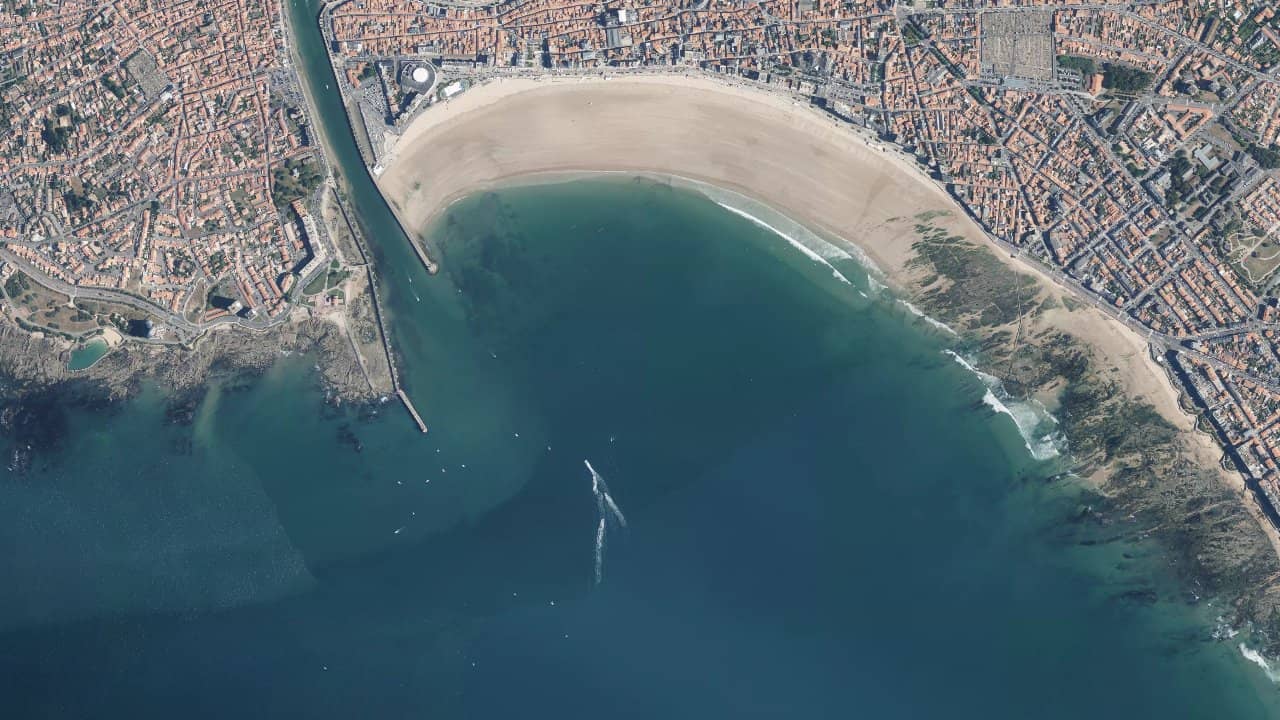
La Grande Plage
France · Pays de la Loire
The Grande Plage of Sables-d’Olonne stretches in a semicircle facing the ocean, bordered by the promenade and the beachfront buildings. It is a large urban beach that is very busy, with a lively seaside resort atmosphere.
It is mainly known for swimming and surfing, but riders sometimes come to check the wind and wave conditions on this section of coast before heading to beaches more suitable for kitesurfing a little further north or south.
Historical averages by month — not a live forecast.
The Grande Plage is generally oriented west/southwest and faces the Atlantic, with a wide sandy bay that reveals itself significantly at low tide. With wind from the W to SW sector, the wind comes in rather onshore to side-on relative to the beach, while a NW wind will be more side-shore. However, the beach is in the middle of the city, very crowded, and heavily regulated, making kitesurfing complicated, if not prohibited at certain times.
A recent municipal decree specifies that towed surfing (kitesurfing) is prohibited on the entire Grande Plage, except for specific exemptions for organized events. Swimming and surfing areas are marked in season, with large sectors reserved for bathers, leaving very little room for a safe kite launch. In practice, riders tend to move to beaches further north (Dunes, Sauveterre) or south (Tanchet, wilder beaches) to find real suitable navigation areas.
The water surface is characterized by a beachbreak, with a sandbank that forms waves of varying size depending on the swell. At low tide, the beach reveals itself significantly and the waves break far from the shore, with a shorebreak that can be marked when the swell is present. At mid-tide and high tide, the shorebreak is often more powerful and the water surface quickly becomes technical, with a lot of foam and turbulence. For a potential launch, the beach width remains adequate at low tide, but at high tide, one quickly finds themselves cramped at the foot of the promenade, which is not suitable for kitesurfing.
Launching generally occurs in front of the main access points for surfers, but again, practice areas are regulated, with specific navigation corridors for sliding sports. Navigation offshore is done along the axis of the bay, with a bottom that remains sandy and even. The waves are often choppy with onshore or side-on wind, and cleaner when the wind is light and the swell is well oriented. For kitesurfing, the combination of an urban environment, crowds, and regulations means that this spot is clearly not a primary spot for navigation, but rather a beach for observation and surfing.
Sources :ville.lessablesdolonne.fr · aloa-vacances.com · surf-sentinel.com · oceanplayers.fr


 Open Windguru forecast