
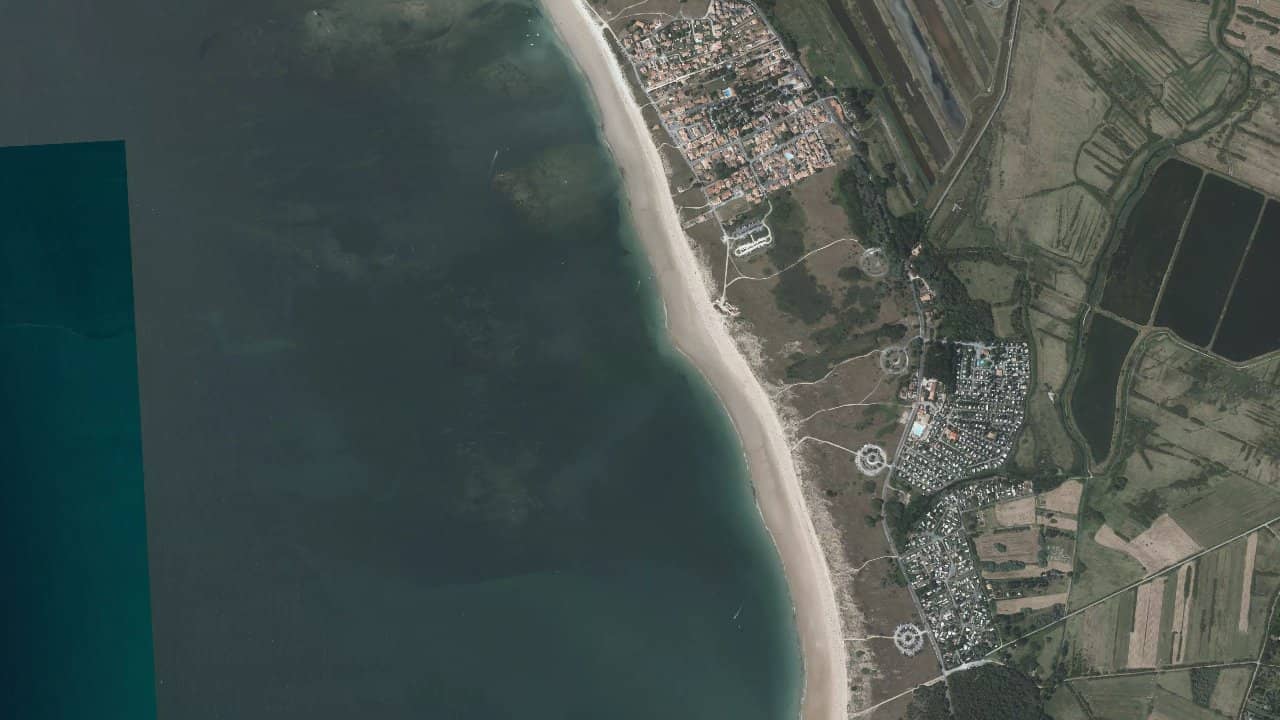
Île d’Oleron - Plage des Huttes
France
Île d’Oleron
The Huttes beach, located in the northwest of the Île d'Oléron in Charente-Maritime, is a long stretch of sand 5 kilometers lined with wild dunes. Directly exposed to the Atlantic Ocean, it is continuously swept by the wind and known for its consistent conditions. It is a spot highly appreciated by riders of all levels, with a kitesurfing zone during the summer season.
The beach sees a high attendance in summer, with the presence of kitesurfing schools, surfers, and other sliding sports practitioners. The atmosphere remains relaxed and friendly, typical of well-established French coastal spots. It is a place where weather conditions are predictable and where finding rental equipment or lessons is not a problem.

Les données de vent affichées ici proviennent d’ERA5 (via Open-Meteo) sur 4 ans, retraitées pour refléter des conditions réalistes.
👉 Le vent moyen a été calibré pour éviter la sous-estimation habituelle des modèles.
👉 Les rafales ont été corrigées par un ratio médian afin d’éviter des valeurs extrêmes irréalistes.
👉 Chaque jour est résumé par le vent médian (P50) observé pendant les heures utiles (8h–20h), puis classé dans des plages de vent.
👉 Le mode pondéré mélange vent moyen et rafales pour refléter au mieux le vent ressenti.
- 🟢 10–16 nds : vent faible mais navigable (notamment en foil).
- 🟡 16–22 nds : plage idéale, conditions confortables pour la majorité.
- 🔴 22–28 nds : vent fort, réservé aux riders expérimentés.
- 🟣 28+ nds : conditions extrêmes, navigation engagée.
Localisation & Points d'intérêt
Informations utiles
Huttes beach works best with a northeast wind orientation, which generates a side-shore to side-on wind depending on conditions. The wind is offshore when blowing from the northeast, creating a smooth water surface ideal for beginners. The best wave orientation is west, but the spot mainly operates in flat water or small swells.
Kitesurfing sessions generally take place at low tide, 3 hours before and 3 hours after. The navigation area is marked by two flags with a free area downwind. The activity stops when the average wind exceeds 30 knots. The depth is shallow in the practice area, making it a secure spot for learning. Caution: in southwest or west wind conditions, the anemometric reading is overestimated by 20% due to a Venturi effect generated by the dune.
Ideal conditions are a northeast wind of 12 to 20 knots, which generates a smooth offshore wind. These conditions allow for pure flat water navigation with excellent visibility and maximum safety. The wind should remain below 30 knots for the activity to be allowed. The best sessions occur with a steady and stable wind, without too many marked gusts.
The water surface is generally flat to slightly choppy with small waves, around 0.4 to 0.5 meters. The period between swells is short, about 7 to 11 seconds. When the wind blows from the northeast, the water surface remains very smooth and ideal for beginners. Conditions can become more choppy with stronger winds or different orientations.
Currents are generally weak at Huttes beach, but caution is needed near the channel where the current can be stronger. Tides play an important role in navigation conditions. At low tide, rocks may emerge and create areas to avoid. At high tide, the water surface is more uniform and safer for navigation.
Recommended kite sizes vary according to wind conditions. For a northeast wind of 12-15 knots, a kite of 11 to 13 square meters is appropriate. For stronger winds, 8 to 10 square meters is sufficient. Schools use low-power kites on short lines for initiation. The choice also depends on the rider's weight and level of experience.
The dominant wind pattern is northeast, which blows regularly and predictably. The wind can reach high speeds, around 29 km/h with gusts up to 41 km/h depending on conditions. This northeast wind is offshore relative to the beach, creating smooth and well-organized conditions. The wind is continuous and reliable, especially in winter and spring.
The Île d'Oléron enjoys a temperate oceanic climate with mild winters and pleasant summers. Water temperatures range from 19-20°C in winter to 20°C at the beginning of the year. The spot operates year-round, with maximum attendance in July and August. Weather conditions are generally stable and predictable, making it a reliable destination for kitesurfing.
La profondeur est progressive avec un fond sableux, ce qui en fait un spot très sûr pour débuter. On a pied jusqu'à 50 mètres du bord environ. La zone de pratique du kitesurf se déroule essentiellement en eau peu profonde, idéale pour l'apprentissage et la progression. À marée basse, la profondeur diminue encore, créant une zone très sécurisée pour les débutants.
Water temperature varies with the seasons. In January and February, it is around 8-10°C. In spring and autumn, it rises to 12-16°C. In summer (July-August), it reaches 18-20°C. A 4/3 mm wetsuit is recommended in winter, and a 3/2 mm or shorty in summer.