France
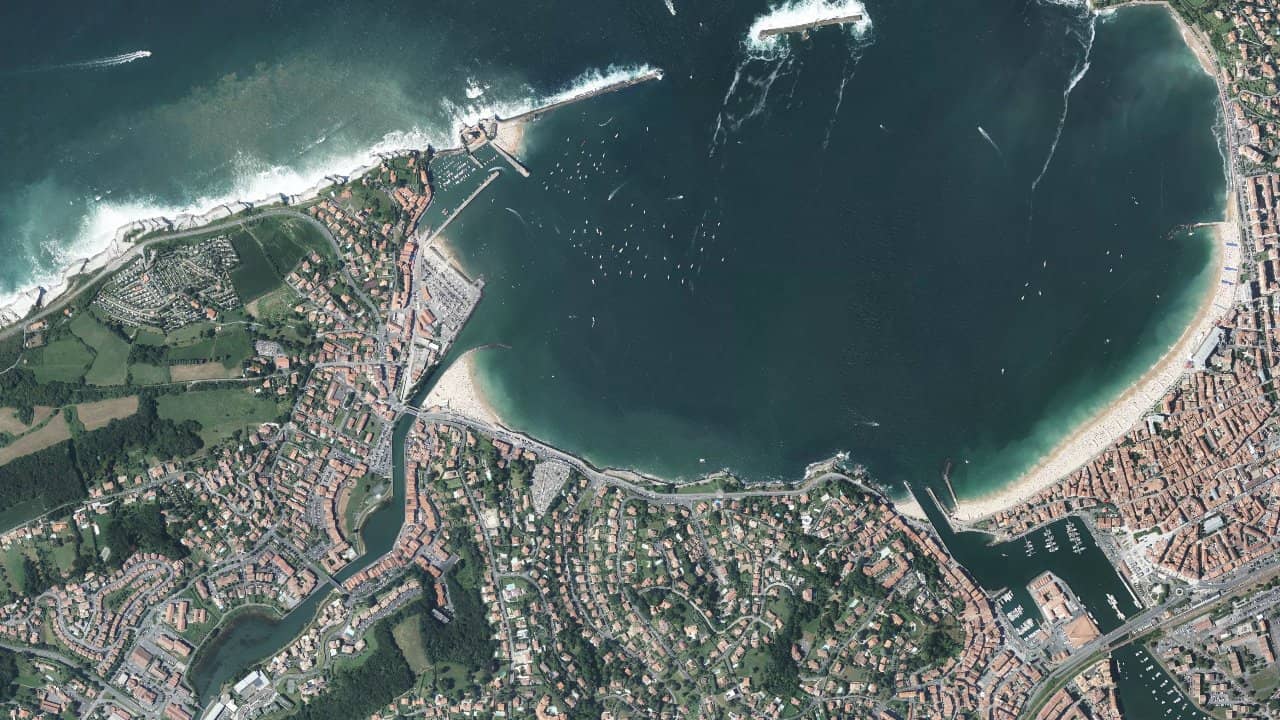
The beach of Ciboure, located in the bay of Saint-Jean-de-Luz, offers a popular kitesurfing spot for its windy conditions and local atmosphere. Nestled in the southwest of the bay, it is sheltered from swells and is well-suited for sessions in strong weather.
It is an authentic place in the Basque Country, with a view of the coast and various water activities around. Riders come here for the steady wind and the proximity to Saint-Jean-de-Luz.
The spot is especially attractive in extreme good weather, with a dedicated area that allows for navigation without too many worries.
The wind data shown here comes from ERA5 (via Open-Meteo) over 4 years, reprocessed to reflect realistic conditions.
👉 Average wind has been calibrated to avoid the usual underestimation of models.
👉 Gusts have been corrected by a median ratio to avoid unrealistic extreme values.
👉 Each day is summarized by the median wind (P50) observed during useful hours (8am–8pm), then classified into wind ranges.
👉 The weighted mode mixes average wind and gusts to best reflect felt wind.
The beach of Ciboure faces west in the bay, making it ideal for side-on winds from the northwest or side-shore from the southwest. The water surface is generally flat to chop thanks to the bay's protection against ocean swells, but it can become choppy at low tide when the water recedes.
Launching is done directly from the fine sand, with a wide take-off area on the southwest beach near Socoa. The navigation area extends about 1 km in the bay, while remaining vigilant about the limits to avoid swimmers in summer. With winds from west to north, it is perfect for freestyle or discovery, with a safe space for beginners.
Be cautious of the tides: at high tide, the water surface is wider and flat; at low tide, you need to navigate close to the shore to avoid dry areas. Sessions work well from mid-tide to high tide, with a local thermal that strengthens the wind in the afternoon during summer.
The ideal conditions are winds of 15 to 25 knots from the northwest or southwest, side-on, with mid-high tide for a wide and flat water surface.
The water surface is protected, so it is often flat or slightly choppy in strong wind. The waves remain small thanks to the bay, perfect for freestyle or freeride.
The currents are moderate in the bay, influenced by the strong local tides. Care should be taken in the central channel where the current accelerates during high or low tide.
Generally safe if you stay in the kite zone near Socoa.
Opt for kites of 9 to 12 m² on average, smaller in strong wind and larger in light thermal.
The prevailing wind comes from the northwest, often between 15 and 25 knots, strengthened by Atlantic depressions. There is a local thermal in the afternoon during summer, which regularly reaches 20 knots.
No specific local name, but it is reliable side-shore wind under low pressure, ideal for long sessions.
The climate of the Basque Country is mild oceanic, with average temperatures of 10°C in winter and 25°C in summer. The seasons extend throughout the year for kiting, with hot and dry summers and mild but rainy winters.
The best months cover January to December according to data, thanks to the constant wind, although summer brings more thermal stability.
The depth is gradual with a sandy bottom. You can stand up to 50-100 meters from the shore depending on the tide.
The water is around 12-14°C in winter and 18-22°C in summer. A 5/4 mm wetsuit is recommended outside the summer season.