France
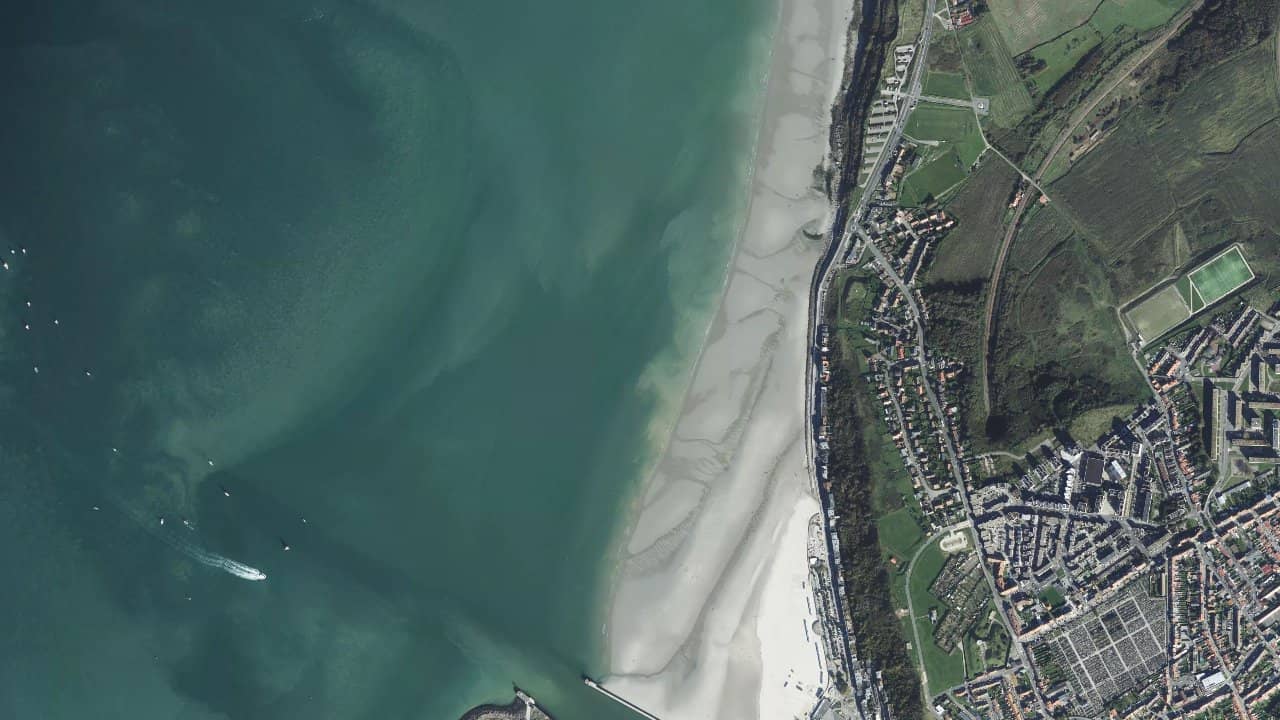
At the foot of the largest fishing harbor in France, the Boulogne-sur-Mer beach is an urban and technical spot on the Opal Coast. Surrounded by dikes, port infrastructures, and a southwest-facing bay, it offers very specific conditions, heavily influenced by the port and the currents of the strait. It is not a postcard spot, but a demanding playground that can offer great committed sessions when the wind and tide are well aligned, mainly for experienced riders.
The wind data shown here comes from ERA5 (via Open-Meteo) over 4 years, reprocessed to reflect realistic conditions.
👉 Average wind has been calibrated to avoid the usual underestimation of models.
👉 Gusts have been corrected by a median ratio to avoid unrealistic extreme values.
👉 Each day is summarized by the median wind (P50) observed during useful hours (8am–8pm), then classified into wind ranges.
👉 The weighted mode mixes average wind and gusts to best reflect felt wind.
Navigating takes place in open sea, in an area influenced by the bay and the immediate proximity of the port. The spot mainly works with winds from west to southwest, arriving side to side-onshore. At low tide, the beach widens and allows for a more comfortable launch. At high tide, the space becomes limited and navigation becomes more complicated. The water is generally choppy to rough, with waves sometimes disorganized due to currents and port structures.

Wind from west to southwest, side to side-onshore, between 15 and 25 knots, with a well-anticipated tide.
Water conditions are choppy to rough, rarely clean. Waves are often short and messy, with turbulence zones near the dikes. The spot is not well suited for flat water or progression.
Strong and complex currents, directly related to tides and port activity. The drift can be fast, especially at high or low tide, and requires constant vigilance.
The most commonly used kite sizes range from 7 to 11 m² depending on the rider's size and wind strength. Smaller kites are common during windy episodes.
Dominant wind from west to southwest, often steady, with typical intensities between 15 and 25 knots. The proximity of the dikes and the port can create disturbed wind zones and gusts near the shore.
Cool and windy oceanic climate, typical of the Strait of Pas-de-Calais. Summers are mild, rarely very hot, while winters are cold, humid, and exposed to frequent winds. The spot is navigable for a large part of the year, with a more comfortable period from spring to autumn.
Depth quickly varies with the tide, with deep areas close to the shore at high tide.
Water temperature ranges from 8–10°C in spring to 18–20°C in summer. A full wetsuit is essential for most of the year.