Australia
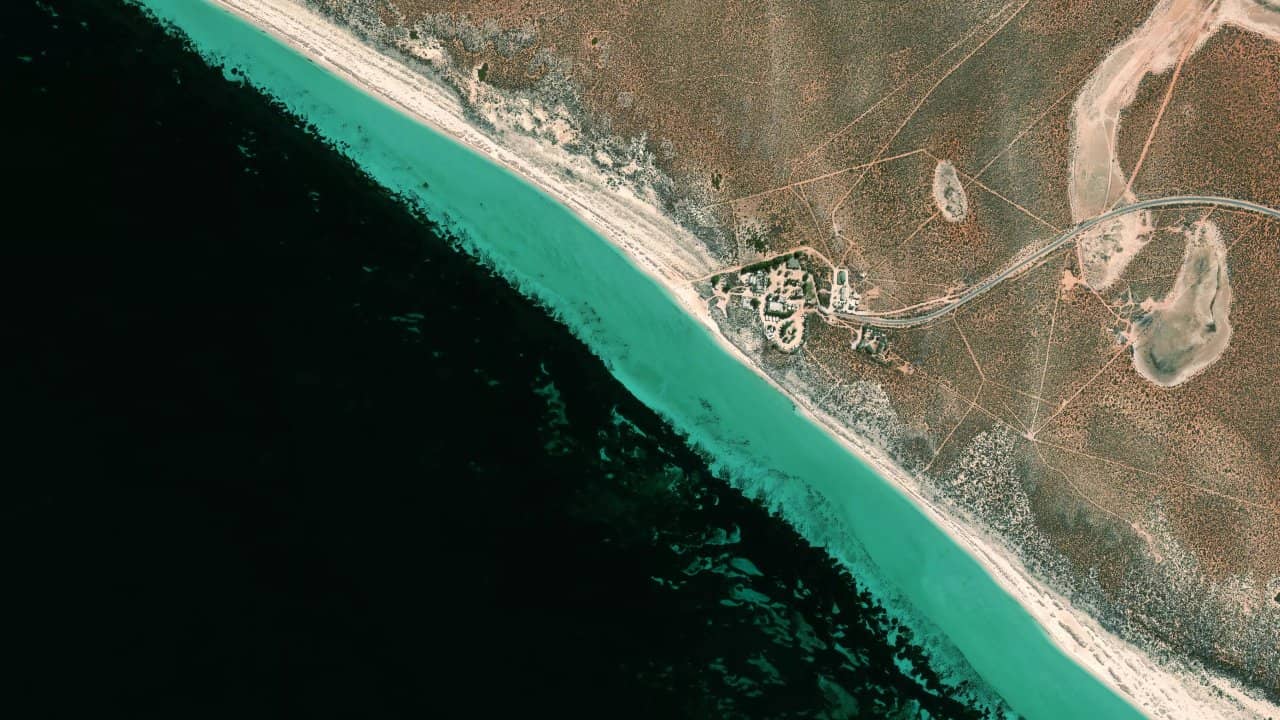
Nanga Bay, located in the southern part of Shark Bay on the west coast of Australia, about a 10-hour drive north of Perth, is an isolated and wild spot that attracts riders seeking authenticity. It is a less crowded place where a sense of freedom prevails, with the possibility to camp directly on the beach facing the spot.
The beach at Nanga Bay offers an immense expanse of white sand particularly appreciated by freestylers due to its flat and less turbulent conditions. The isolation of the spot is both an advantage for riders seeking tranquility and a logistical disadvantage in case of equipment issues.
Les données de vent affichées ici proviennent d’ERA5 (via Open-Meteo) sur 4 ans, retraitées pour refléter des conditions réalistes.
👉 Le vent moyen a été calibré pour éviter la sous-estimation habituelle des modèles.
👉 Les rafales ont été corrigées par un ratio médian afin d’éviter des valeurs extrêmes irréalistes.
👉 Chaque jour est résumé par le vent médian (P50) observé pendant les heures utiles (8h–20h), puis classé dans des plages de vent.
👉 Le mode pondéré mélange vent moyen et rafales pour refléter au mieux le vent ressenti.
Nanga Bay benefits from a very regular and reliable wind that generally blows from south-southwest to southwest, creating side-on to side-shore conditions ideal for riding. The water surface is exceptionally flat inside the bay, with a slight chop outside depending on conditions. Entry is easy from the large beach, and the takeoff area is very spacious. Riders report a current heading north that can affect progress in light wind. The bay offers a natural protection that keeps the water flat even with moderate wind, making it an ideal playground for progressing in freestyle.
Ideal conditions at Nanga Bay occur with a south-southwest to southwest wind between 12 and 20 knots. These conditions offer a perfect balance between power and control, particularly for freestyle practice. Light wind is possible but less ideal as it can be affected by the north current. Conditions are excellent all day thanks to the regularity of the wind.
The water surface at Nanga Bay is remarkably flat inside the bay, with shallow sandy water. Outside the protected bay, there is a slight chop characteristic of Shark Bay. The water remains flat and stable even with moderate winds due to the natural protection of the bay. Visibility is generally good, with a sandy bottom visible in shallow water.
The current at Nanga Bay is generally weak to moderate, but there is a current heading north that can be felt, especially in light winds. This current can affect your progress if you are riding to the left with little wind. Tidal conditions do not significantly influence kitesurfing conditions at this spot.
For Nanga Bay, the recommended kite sizes vary according to wind conditions. With a moderate wind of 12-15 knots, a 13-14 m² kite is ideal. For stronger winds of 15-20 knots, an 11-12 m² kite offers more control. In case of light wind, a 15-17 m² kite may be necessary to maintain progress.
The wind regime at Nanga Bay is dominated by south-southwest to southwest breezes that blow very regularly and reliably. These winds are less gusty than at other spots in Shark Bay, providing stable conditions for practice. The wind is generally moderate to good during the main season, with predictable gusts.
Nanga Bay enjoys a semi-arid climate typical of the Australian west coast. Temperatures are warm year-round, with mild winters and very hot summers. The region experiences little rainfall, ensuring regular sunny days.
Nanga Bay offers a gradual and very accessible depth with a completely sandy bottom. You can stand easily up to 50 meters from the shore, making it an extremely safe spot for all levels. The depth increases gradually, allowing for easy entry and takeoff.
The water at Nanga Bay is warm and pleasant during the main season. Temperatures vary by season, with warm waters from December to March (around 22-24°C) and cooler waters from April to November (around 18-21°C). A lycra or shorty is usually sufficient during the warm season, while a light wetsuit may be considered in Australian winter.